

Top 5 VR Skateboarding Games 2025
Virtual reality skateboarding has reached new heights in 2025, offering games that let you experience skating like never before. These games cater to different styles, from realistic simulations to multiplayer social experiences. Here are the top five VR skateboarding games of the year:
- Virtual Skate: A physics-based skate simulator for PCVR and Meta Quest 3, perfect for those seeking a challenging and precise skating experience.
- VR Skater: SL: A hand-tracked simulation game with natural trick controls, available on Meta Quest and PCVR.
- Tony Hawk's VR Skate Experience: Combines iconic combo-based gameplay with motion controls, supporting multiple platforms like Meta Quest, PCVR, and PSVR2.
- Shred Space: A hybrid skate game with a mix of realism and arcade fun, featuring trick editors and online leaderboards.
- SkateVerse Social: Focuses on multiplayer interaction, park building, and live events, offering a community-driven skateboarding experience.
Quick Comparison
| Game | Platforms | Price (USD) | Style | Features | Motion Comfort |
|---|---|---|---|---|---|
| Virtual Skate | PCVR, Meta Quest 3 | $19.99–$29.99 | Realistic simulation | Trick practice, free-skate parks | 2–3 |
| VR Skater: SL | Meta Quest, PCVR | $19.99–$29.99 | Realistic simulation | Challenges, leaderboards, multiple parks | 3 |
| Tony Hawk's VR Skate | PCVR, PSVR2, Meta Quest 3 | $29.99–$34.99 | Arcade/combo-focused | Licensed parks, trick tutorials | 4 |
| Shred Space | PCVR, PSVR2 | $24.99–$29.99 | Hybrid sim/arcade | Trick editor, leaderboards | 3–4 |
| SkateVerse Social | PCVR, Meta Quest 3, PSVR2 | $24.99–$29.99 | Social/multiplayer | Park builder, live events, voice chat | 4 |
Each game offers something different, from precision skating to social hangouts. Whether you're into mastering tricks or connecting with friends, there's a VR skateboarding game for you.
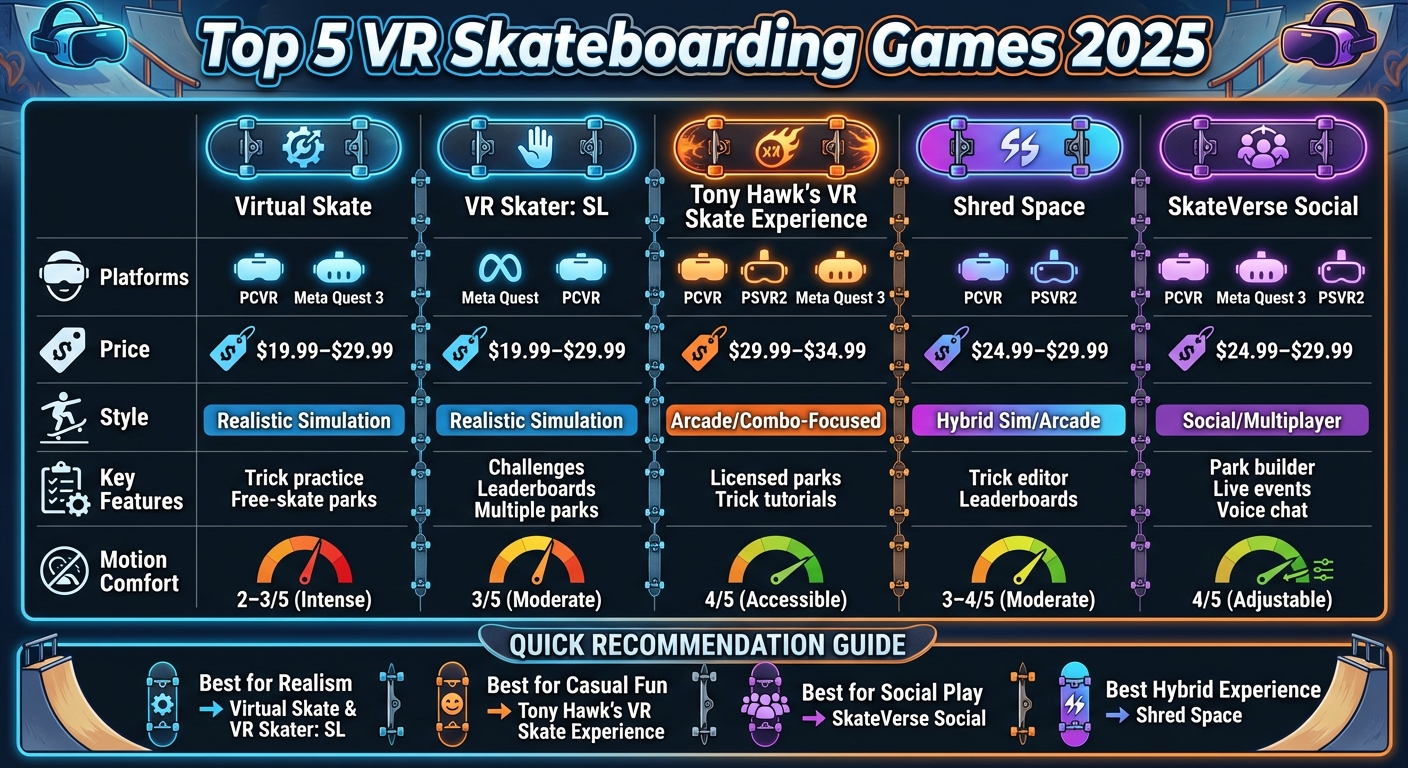
Top 5 VR Skateboarding Games 2025: Platform, Price & Features Comparison
Virtual Skate Early Access Review – Can Quest 3 Finally Deliver a VR Tony Hawk?
1. Virtual Skate
Virtual Skate is an upcoming VR skateboarding game from Flip Axis Studios, the creators of Skater XL. Known for its realistic analog stick controls and physics-based gameplay, the studio is now bringing its expertise to the world of virtual reality. This new adaptation takes a simulation-first approach, translating full-body motion into precise board control and trick execution. The goal? To deliver an experience that feels as close to real skateboarding as possible.
The game will be available on SteamVR (PC VR) and Meta Quest 3/3s, with support for Vive and other OpenXR-compatible headsets on PC. For the best experience, players will need either a standalone Quest 3 or a PC setup with reliable tracking. The gameplay is designed for room-scale VR, where players lean and shift their weight to control the board, making it an immersive and physical experience.
Fans of games like Skater XL and Session will feel right at home with Virtual Skate, as it emphasizes mastery through practice. The HTC Vive blog describes it as a "simulation game" rather than an arcade-style experience, highlighting the importance of precision and dedication to perfecting tricks and lines.
While pricing details haven’t been revealed yet, similar VR sports games typically launch in the $19.99–$39.99 range in the U.S. Virtual Skate also plans to incorporate community-driven mods and custom skate spots, offering players even more ways to engage with the game.
To ensure a comfortable experience, the game includes standard VR features like snap turning, an adjustable vignette, and both standing and seated modes. These options are designed to reduce motion sickness and make the game accessible to a broader range of players.
2. VR Skater: SL
VR Skater: SL is a skateboarding simulation game available on Meta Quest, described on the Meta Store as "the most authentic, challenging, and immersive skating game ever". Unlike arcade-style skateboarding games, it emphasizes realistic board control by using hand-tracked motion controls instead of relying on simple button presses. This approach brings a hands-on experience, especially in its trick system.
The trick system is all about natural hand gestures and precise timing. With each Meta Quest controller acting as a virtual hand, players can mimic real skateboarding movements to perform tricks like ollies, kickflips, and grinds. For example, executing a multi-step trick sequence requires accurate wrist flicks and movements. Steam users frequently praise the game for its realistic feel and the rewarding progression curve that allows players to transition from mastering basic moves to chaining together advanced combos.
The game takes this realism further with urban-themed levels designed to test every skill level. You'll find street plazas and skate parks offering mission-based runs, score challenges, and time trials to keep the gameplay competitive and engaging. Metacritic describes it as a "pick up and play simulator" that’s easy to get into but deeply satisfying as you master its mechanics.
To address motion sickness, VR Skater: SL includes features like adjustable vignettes, snap or smooth turning, and options to customize stance and board height. These features, combined with its physically demanding gameplay - almost like a light workout - make it essential to have a safe play area, use wrist straps, and take regular breaks. The Meta Store rates the comfort level as "Moderate–Intense."
The game is priced between $19.99 and $29.99 on the Meta Store, with a PC VR version available on Steam at a similar price range. The PC version offers enhanced graphics and supports headsets like the Valve Index, HTC Vive, Oculus Rift/Quest via Link, and Windows Mixed Reality. If you’re looking for a skateboarding experience that leans more toward simulation than arcade-style action, VR Skater: SL delivers on that promise.
3. Tony Hawk's VR Skate Experience
Tony Hawk's VR Skate Experience takes the realism of previous VR skateboarding games up a notch by introducing classic tricks through motion controls that feel natural and engaging.
This VR adaptation reimagines the franchise's well-known combo system, replacing traditional button inputs with gesture-based controls. The challenge for developers has been to make iconic moves like ollies, kickflips, and grinds feel seamless and precise within the immersive world of VR.
The game combines Tony Hawk's signature combo chains with motion-controller gestures, offering a gameplay experience that demands both skill and precision. Supported devices include standalone headsets like the Meta Quest 3/3s and PC VR systems such as Valve Index and HTC Vive.
To ensure a comfortable experience for all players, the game will feature options like adjustable vignettes, sensitivity settings, and even seating modes to reduce the risk of motion sickness.
Adding to the authenticity, the game will include branded in-game assets. Expect deck art and skate parks inspired by real-world skate culture, featuring designs from Carbonated Thoughts (https://carbonatedthoughts.store). This connection bridges the virtual and real worlds, making the game feel like a genuine extension of skateboarding culture.
sbb-itb-e116ef9
4. Shred Space
Shred Space is an upcoming VR skateboarding game set to launch in 2025. While specific details about gameplay, platform compatibility, and features are still under wraps, early hints suggest the game aims to be welcoming for everyone - whether you're a complete beginner or a seasoned skater.
What sets this project apart is its focus on community involvement. Player feedback will shape the game's updates, ensuring it evolves throughout 2025 to meet the needs and expectations of its audience.
5. SkateVerse Social
SkateVerse Social takes a different approach compared to most VR skateboarding games, which often focus on individual challenges and leaderboards. This game puts the spotlight on community interaction, offering features like drop-in multiplayer sessions, collaborative park building, and shared jam sessions where players can skate together. By combining these social elements with advanced trick mechanics, it creates a skateboarding experience that feels fresh and connected.
The trick system is designed to be intuitive yet rewarding for both beginners and seasoned players. You’ll use gesture-based controls to perform tricks - flick your controllers for ollies and kickflips, tilt them for grinds and reverts, and even use headset movements to balance during manuals. It’s compatible with major VR platforms, including Meta Quest 3/3s (stand-alone), PC VR via SteamVR, and potentially PS VR2, ensuring accessibility for a broad audience of U.S. players.
The game’s environments are entirely user-driven, featuring custom-designed parks that are continuously updated. A park editor allows players to create and share their own skate spots, adding a layer of creativity to the experience. Weekly featured parks and live events keep the gameplay dynamic, while integrated tools like voice chat and clip recording make it easy to share your best runs with friends. These features pair seamlessly with the game’s physical controls, offering an immersive and comfortable experience.
To address motion sickness, the game includes multiple comfort settings: adjustable vignette effects, options for snap or smooth turning, movement sensitivity sliders, and a "chill mode" that slows down gameplay and simplifies physics. Players can also switch between seated and standing modes and tweak camera height and field of view to suit their preferences.
Priced at around $24.99–$29.99, SkateVerse Social positions itself as a community-driven alternative to traditional VR skate games. With its balance of realistic mechanics, accessibility features, and a strong focus on social interaction, it’s perfect for those who’d rather skate with friends than chase solo high scores. Coming in 2025, it promises to bring a fresh vibe to VR skateboarding.
Game Comparison Table
Here’s a quick rundown of five VR skateboarding games, comparing platform availability, pricing, gameplay style, content variety, and motion comfort (rated 1–5). Platform compatibility is a big deal in 2025, whether you're using a standalone headset or a tethered system. Prices are listed in USD. Gameplay style shows whether the focus is on realistic simulation or more arcade-like mechanics. Content variety highlights what keeps players engaged - whether it's multiplayer modes, custom parks, or challenge runs. Lastly, the motion comfort rating (1 = intense, 5 = very comfortable) indicates how well the game accommodates motion-sensitive players, factoring in features like snap turning and vignette effects. Check out the table below for a side-by-side comparison.
| Game | Platform(s) | Price (USD) | Gameplay Style | Content Variety | Motion Comfort (1–5) |
|---|---|---|---|---|---|
| Virtual Skate | PCVR (SteamVR), Meta Quest 3/3s | ~$19.99–$29.99 | Hardcore sim | Realistic physics, trick practice, challenge runs, free-skate parks | 2–3 (intense sim) |
| VR Skater: SL | Meta Quest (standalone) | ~$19.99–$29.99 | Realistic sim | Multiple parks, challenges, leaderboards, comfort settings | 3 (with options) |
| Tony Hawk's VR Skate Experience | PCVR, PSVR2, Meta Quest 3/3s | ~$29.99–$34.99 | Arcade/combo-focused | Licensed parks, combo challenges, trick tutorials, score attack | 4 (accessible) |
| Shred Space | PCVR (SteamVR), PSVR2 | ~$24.99–$29.99 | Hybrid sim/arcade | Vert and street modes, trick editor, online leaderboards, replays | 3–4 (moderate) |
| SkateVerse Social | PCVR (SteamVR), Meta Quest 3/3s, PSVR2 | ~$24.99–$29.99 | Social/community-driven | Drop-in multiplayer, park builder, live events, voice chat, clip recording | 4 (adjustable) |
If you're after authentic, skill-based skating, Virtual Skate and VR Skater: SL offer the most realistic board control but come with lower comfort ratings due to intense motion. On the other hand, Tony Hawk's VR Skate Experience and SkateVerse Social are perfect for players seeking casual fun or social hangouts, with higher comfort scores and features that make gameplay more forgiving. Shred Space strikes a balance, blending realism with accessibility, making it a good choice for those who want a challenging yet manageable experience.
Conclusion
Each VR skateboarding game offers something unique for every skate style. Virtual Skate and VR Skater: SL focus on skill-based progression for those seeking a realistic challenge. Tony Hawk's VR Skate Experience brings fast-paced, arcade-style tricks to the table, while Shred Space lets players unleash their creativity with its futuristic vibe. Meanwhile, SkateVerse Social reimagines VR as a space for social skating, blending community and gameplay. Together, these games highlight how VR is reshaping the way we experience skateboarding.
By 2025, VR skateboarding has become a great entry point for beginners. It’s a safe, weatherproof way to learn trick names, experiment with lines, and dive into skate culture. The low-risk environment also encourages players to test bold ideas and tackle obstacles that might be too dangerous in real life. These virtual experiments can even inspire fresh approaches to real-world skate spots and park designs. And as VR hardware becomes more affordable and precise, we might see even more immersive features, like advanced board peripherals or haptic feedback, further bridging the gap between virtual and real skating.
On the other side of the spectrum, Carbonated Thoughts is bringing the energy of VR skateboarding into the real world. This platform celebrates skate culture with art-inspired skateboards, streetwear, and home decor, often tied to causes like its Carbonated Racing initiative, which plants a tree for every deck sold. Whether you’re stepping onto a physical board for the first time or showcasing the style you’ve perfected in-game, Carbonated Thoughts connects the virtual and physical worlds of skateboarding, enriching the culture and strengthening the community.
FAQs
What makes Tony Hawk's VR Skate Experience stand out from other VR skateboarding games?
Tony Hawk's VR Skate Experience is all about bringing the real feel of skateboarding into the virtual world. Thanks to its realistic physics, players can experience the rush of pulling off authentic skateboarding moves. Whether you're flipping through a detailed trick library or designing your own custom skateparks, the game lets you create the skating setup of your dreams.
The immersive VR interface takes things up a notch with lifelike visuals and intuitive controls. It’s designed to make pulling off tricks and exploring dynamic environments feel natural and exciting. With its sharp attention to detail and commitment to realism, this game has become a go-to for skateboarding fans who want to take their passion into VR.
How comfortable are the motion controls in these VR skateboarding games?
When it comes to VR skateboarding games, the level of motion comfort can differ a lot. Some games focus on creating smooth and natural movements to help players feel at ease and avoid motion sickness. On the other hand, some might include quicker or more sudden camera movements, which can be uncomfortable for certain players.
Game developers are always working to fine-tune motion systems to make the experience better. However, how comfortable a game feels often comes down to a mix of personal sensitivity to VR motion and the unique mechanics of each game.
Which devices can you use to play the best VR skateboarding games in 2025?
The top VR skateboarding games in 2025 work seamlessly across a range of devices, including PC VR headsets and standalone systems. Some of the most popular choices are the Oculus Quest 2, Quest Pro, HTC Vive, Valve Index, and PlayStation VR.
No matter if you prefer the deep immersion of a high-end setup or the convenience of a portable option, these platforms deliver smooth gameplay and impressive visuals, making your virtual skateboarding experience unforgettable.