
Street Artists Fighting for Climate Justice
Street art is becoming a powerful voice in the fight against climate injustice. Artists are using public spaces to highlight how climate change disproportionately affects marginalized communities. From murals addressing rising sea levels to installations combating urban heat, these works spark conversations and inspire action. Key examples include:
- Boston: Lani Asunción's "SONG/LAND/SEA" installation sheds light on flood risks and equity in vulnerable neighborhoods.
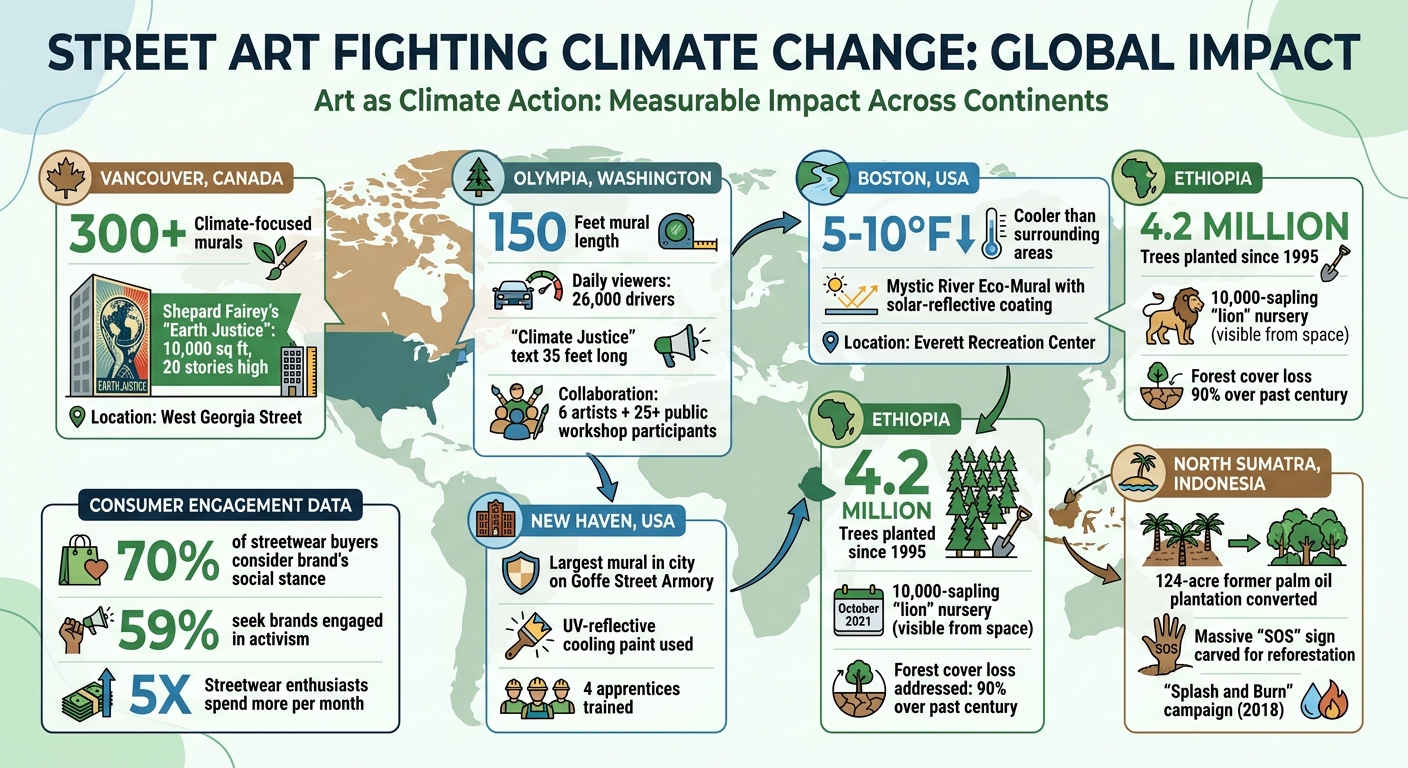
- Vancouver: The Vancouver Mural Festival’s "Climate Collection" features over 300 murals, including Shepard Fairey's "Earth Justice."
- Olympia, WA: A 150-foot-long mural by Carrie Ziegler and collaborators brings daily awareness to 26,000 drivers.
- Ethiopia: Hussein Watta’s tree-planting "plant graffiti" has resulted in over 4.2 million trees planted since 1995.
These projects bridge art and activism, addressing issues like flooding, heat islands, and deforestation. Platforms like Carbonated Thoughts further support artists by offering tools, merchandise, and services to amplify their messages. This movement underscores the role of art in driving awareness and action for a fairer climate future.
Global Street Art Climate Justice Projects: Impact by Numbers
Case Studies: Street Artists Fighting for Climate Justice
Vancouver's Greenest City Public Art Initiatives
Vancouver has turned its vibrant street art scene into a powerful voice for climate advocacy. The Vancouver Mural Festival (VMF) plays a key role with its "Climate Collection", a series of over 300 murals accessible through a mobile app. These artworks aim to spark public conversations about nature and climate issues.
In August 2019, Shepard Fairey collaborated with the Burrard Arts Foundation and VMF to create "Earth Justice", a massive mural spanning 10,000 square feet and towering 20 stories high on West Georgia Street. The artwork features a globe held by hands and surrounded by broken chains, rendered in shades of blue, turquoise, and white. Fairey explained his approach:
"When art appeals emotionally, it subconsciously triggers intellectual reflection".
Jean Huang took a different approach in 2022 with her installation "Handshake with Kelp" in the Helmcken/Mainland Street plaza. Her three-dimensional mural simulates rising sea levels, with waves spilling over ledges to symbolize the ocean encroaching on land. Huang shared her vision:
"When above the mural, waves spill over the ledge onto 'land,' - giving the impression of sea levels rising... I hope the mural creates wonder and encourages people to learn more about the ocean and climate change".
Guest curator keiko Hart highlighted the festival's dedication to inclusivity, noting:
"The artists I've curated for the Climate Collection center the voices of Indigenous and racialized bodies that are at the forefront of these climate activism movements".
These efforts demonstrate how public art can inspire awareness and action on local environmental issues.
Mystic River Eco-Murals in Boston
In July 2024, the Mystic River Watershed Association unveiled an innovative mural at the Everett Recreation Center in Massachusetts. Designed by Ashley Fitzgerald and six Everett High School students, the mural features a solar-reflective coating that keeps its surface 5 to 10°F cooler than surrounding areas.
Marissa Zampino, a Community Organizer with the Mystic River Watershed Association, explained the mural's practical impact:
"The mural's solar reflective coating is designed to prevent heat absorption. It demonstrates how painting surfaces a lighter color, or with a cooling sealant, can help combat the urban heat island effect".
The mural also incorporates American Sign Language elements that spell out "Everett" in bright colors, emphasizing both accessibility and environmental awareness.
Yogyakarta's Apotik Komik Project and Related Collaborative Initiatives
Community-driven street art projects around the world are amplifying calls for climate justice. While details about Yogyakarta's Apotik Komik Project are limited, its inclusion reflects the global reach of these initiatives. Collaborative design and youth engagement often play a key role in fostering community involvement and environmental action.
In Olympia, Washington, the TCAT Climate Justice Mural stands as a prime example of this collaborative spirit. Lead artist Carrie Ziegler worked with a design team of six artists, the Thurston Climate Action Team, and the Squaxin Island Tribe to create a 150-foot-long mural on Olympic Way. The project included public design workshops with over 25 participants and community painting days, ensuring that diverse voices shaped the final piece. Located along a busy road with approximately 26,000 daily drivers, the mural delivers its message to a wide audience. Reflecting on its impact, Ziegler remarked:
"Twenty-six thousand cars drive by the new mural every day... Every day they read the 35-foot long statement: Climate Justice".
sbb-itb-e116ef9
The Impact of Street Art on Climate Justice Efforts
Measured Results: Environmental and Social Benefits
Street art has shown it can deliver real environmental and social advantages. Take Olympia's Climate Justice Mural as an example - its climate-focused messages reach over 26,000 vehicles daily. This kind of exposure transforms complex ideas into unavoidable, everyday reminders for commuters, transit riders, pedestrians, and cyclists alike. Unlike traditional campaigns, this constant visibility builds awareness in a unique and powerful way.
Some projects go even further, directly addressing environmental challenges. In October 2024, artist Mike DeAngelo, along with four apprentices, completed New Haven's largest mural on the Goffe Street Armory. They used UV-reflective cooling paint, which helps lower surface temperatures and counters the urban heat island effect in the Dixwell neighborhood.
Then there’s Ethiopia’s remarkable "plant graffiti" initiative. Since 1995, Hussein Watta and the Rural Organization for Betterment of Agro-Pastoralists (ROBA) have planted an astounding 4.2 million trees through their environmental art projects. One standout example came in October 2021, when they created a 10,000-sapling "lion" nursery in a Kofele schoolyard - visible from space. This initiative not only addresses Ethiopia's dramatic 90% forest cover loss over the past century but also incorporates environmental art into the national school curriculum.
Artist-Led vs. Government-Led Initiatives: A Comparison
The way these projects are managed - whether artist-led or government-led - shapes their community impact in distinct ways. Artist-led efforts often bring grassroots energy and bold, emotional storytelling. For example, the 2018 "Splash and Burn" campaign in North Sumatra, led by Lithuanian artist Ernest Zacharevic, made a global statement. Partnering with the Sumatra Orangutan Society and Lush, Zacharevic carved a massive "SOS" sign across a 124-acre former palm oil plantation purchased for reforestation. These kinds of projects challenge industrial practices head-on and amplify their messages worldwide.
On the other hand, government-led initiatives offer structure, funding, and access to high-profile locations. Olympia’s December 2021 Climate Justice Mural, for instance, was supported by the City of Olympia’s "Grants to Arts and Culture Organizations" program. Similarly, New Haven’s mural project included an apprenticeship program, providing local artists with hands-on training in large-scale mural techniques.
The best results often come from blending these approaches. Olympia’s mural is a great example - it combined city funding with the creative freedom of a diverse, six-artist design team. This team included Indigenous leaders from the Squaxin Island Tribe and hosted public design workshops during a record-breaking heatwave. Lead artist Carrie Ziegler highlighted the project’s deeper purpose:
"This project is one way to get the community together to have conversations around climate justice, to look into finding solutions for this ginormous problem... and create community while we're doing it".
How Platforms Support Street Artists and Climate Activism
Carbonated Thoughts' Support for Creative Activism

Street artists often need spaces where their creative work can intersect with activism. Carbonated Thoughts steps in as a creative collective that provides tools to amplify environmental messages beyond just murals. One of their standout offerings is activist streetwear, featuring bold climate-focused slogans like "Knock Knock Climate Change", "Climate Change is Here", and "Save the Bees." These designs aren't just fashion - they're conversation starters, turning wearers into walking advocates for environmental awareness. Even better, the streetwear is made using eco-conscious materials such as organic cotton and recycled polyester. This aligns with consumer values, as 70% of streetwear buyers consider a brand's stance on social issues, and 59% actively seek out brands engaged in activism when making purchases.
Beyond clothing, Carbonated Thoughts also offers skateboards and art prints, giving artists more ways to express their values. Prices range from $35 for organic cotton tees to $85 for premium hoodies, with recycled polyester swim trunks priced at $75. Interestingly, streetwear enthusiasts are known to spend up to five times more per month on these items compared to non-streetwear purchases. By integrating activism into everyday products, Carbonated Thoughts creates a seamless way for consumers to engage in environmental conversations.
Building Climate Justice Brands with Creative Services
Carbonated Thoughts goes beyond merchandise by providing creative services that help artists transform their activism into sustainable brands. For instance, their Creativity & Brainstorming service, priced at $30/hour, helps artists refine their ideas into impactful messages. Meanwhile, their Business Consulting service, available at $100/hour, guides creators in turning their artistic visions into viable business ventures. Additional services include Graphic Design at $55/hour (with a three-hour minimum) and Website & Online Store Setup at $100/hour (also with a three-hour minimum). These services address a common challenge for artists: while they excel in crafting compelling environmental messages, they often lack the tools to scale their efforts into lasting movements.
As the platform itself emphasizes, "Carbonated Thoughts is an inclusive group of creatives. All are welcome here!!". This direct-to-consumer approach reflects broader trends in the streetwear industry, where brands increasingly manage their own platforms to build tight-knit communities and foster exclusivity. By blending creativity, activism, and business support, Carbonated Thoughts empowers street artists to make a lasting impact.
Shepard Fairey reimagines 'Earth Justice' for Climate Week NYC
Conclusion: Art's Role in Building a Climate-Conscious Future
Street art transforms climate justice from a distant concept into something tangible and immediate. By creating murals in neighborhoods most impacted by environmental racism, artists shine a light on critical issues like rising sea levels and urban heat islands. As Favianna Rodriguez, President of the Center for Cultural Power, puts it:
"The power of art and culture is that it speaks to our heart. It speaks to our emotions, but it also opens up our imagination to show us what's possible".
These examples prove that climate-focused art goes beyond visual appeal - it drives real-world environmental change.
Street art also amplifies marginalized voices, ensuring their stories are heard. Artist Lukaza Branfman-Verissimo explains this beautifully:
"Art is another language or tool to digest some of these heavy things or big political moments that are around us".
When BIPOC artists take the lead, they bring genuine perspectives on environmental injustice to the forefront.
Looking ahead, the future of climate activism lies in partnerships between artists, platforms, and communities. Programs like apprenticeships and creative collectives highlight how artistic activism can thrive. By weaving together storytelling and practical solutions, street art helps craft a vision for a regenerative and inclusive future.
FAQs
How does street art help advance climate justice?
Street art plays a key role in promoting climate justice by turning public spaces into platforms for awareness and action. Through murals and installations, artists break down complex issues like pollution and climate change into visuals that resonate emotionally with people. These pieces don’t just decorate walls - they invite communities to engage, spark meaningful conversations, and highlight voices that often go unheard. In this way, street art becomes more than creativity; it becomes a force for collective action and environmental advocacy.
What makes a climate mural “community-led” or inclusive?
A climate mural is considered community-led or inclusive when it actively involves local residents and incorporates diverse perspectives throughout its design, creation, and messaging. By doing so, the mural becomes a reflection of shared values, lived experiences, and collective aspirations tied to climate justice. Inclusivity also prioritizes uplifting the voices of those most impacted by climate challenges, creating opportunities for empowerment and meaningful dialogue. These murals go beyond being mere artwork - they serve as catalysts for collective action and community engagement.
How can I support climate-focused street artists through Carbonated Thoughts?
Support climate-conscious street artists by exploring Carbonated Thoughts. They offer a range of art, streetwear, and accessories that shine a light on social and environmental issues. You can also take it a step further by collaborating with or commissioning these artists for murals or projects that focus on climate justice. Sharing their work on social media or getting involved in community art projects is another great way to amplify their message and keep their mission alive.