
Street art and democracy
Street art is public speech on public surfaces. In this piece, I see one main point: when people paint, paste, or write in shared space, they are taking part in city life, whether officials approve or not.
Here’s the short version:
- Street art puts civic speech in daily view. People see it on walls, sidewalks, and transit routes without paying for access.
- Different formats do different jobs. Murals can stay up for years, while stencils, wheatpastes, and posters can react fast to a crisis.
- Public art can pull more people into local life. The Olympia-Rafah mural involved 150+ groups and individuals. A Juneteenth project in Bucks County used 160 canvases - one for each year since the first Juneteenth.
- Who controls the wall controls part of the public conversation. Zero-tolerance rules remove unpermitted work. Permission walls open space, but only inside set rules.
- There’s a tradeoff. Street art can support memory, protest, safety plans, and neighborhood pride. It can also be used for branding or tied to rising rents.
A few facts stand out to me:
- Evanston, Illinois, opened a legal permission wall in July 2026.
- In Downtown Brooklyn, the Shared Streets project turned sidewalks into painted public space tied to traffic calming.
- In Forest Hills, Queens, a wall project ran across 180 feet and let residents vote on the imagery.
- One mural in Olympia covered a wall 46 feet high by 78 feet wide.
My takeaway: democracy in a city is not just voting or going to meetings. It is also who gets seen, who gets heard, and who gets to leave a mark in shared space.
If I had to sum up the article in one line, it would be this: street art shows that public space is never neutral.
Public Program: "Murals That Matter: Activism Through Public Art"
sbb-itb-e116ef9
Street art as public expression
Street art is public art made outside galleries and museums. Because it’s low-cost, flexible, and easy to see, it works as a direct form of civic speech. A mural, stencil, or poster can turn an ordinary wall into a public statement. And those differences matter. Each form reaches people in its own way and invites a different kind of reaction.
Philip Silva put it plainly:
"Street art is rough around the edges, comfortable in messy environments, and comfortable with being temporary. You don't get lost in street art; it keeps you grounded in the city. Instead, it roots you even more firmly in the radical uniqueness of a particular urban place."
Street art can also help organize collective struggle and political agitation.
Forms of street art in public space
Each format does a different job. Murals are often large-scale and community-led. They can hold collective memory in public view while backing social justice efforts. In Sandtown-Winchester, Baltimore, Nether and resident Brandon Ross created a mural after Freddie Gray's death, placing him beside Rosa Parks and Martin Luther King Jr. The mural became a site of community mourning tied to the Black Lives Matter movement.
Graffiti grows out of tagging, or writing names on trains and walls, and it still stands as a direct form of personal expression. Stencils are faster to apply, but they can still carry detailed imagery and sharp political messages. That’s one reason they show up so often in activist campaigns. Protest posters work a bit differently. They act as tools of political agitation meant to challenge dominant narratives and spark a response.
These formats aren’t just about style. They also show who has access to tools, how much time an artist has, how much risk they can take, and how far a message needs to travel. Once public art enters shared space, it also steps into disputes over control, permission, and who gets seen.
Why walls become public forums
When street art enters daily life, the space becomes part of the message. Walls, sidewalks, and transit corridors aren’t neutral backdrops; they’re part of how people move through the city every day. That makes them natural sites for public conversation. For communities shut out of official civic spaces, that visibility can matter a lot. When a city surface becomes a canvas, residents get a way to take part in the public sphere through visual dialogue.
In Downtown Brooklyn, NY, the Downtown Brooklyn Partnership backed the 2026 "Shared Streets" initiative, which turned sidewalks into a public gallery with oversized floral and abstract asphalt art designed to slow traffic and improve pedestrian safety. The project showed that even the ground beneath your feet can say something about who a city is built for. When communities paint in shared space, they stake a claim to voice, memory, and belonging.
How street art drives civic participation and public debate
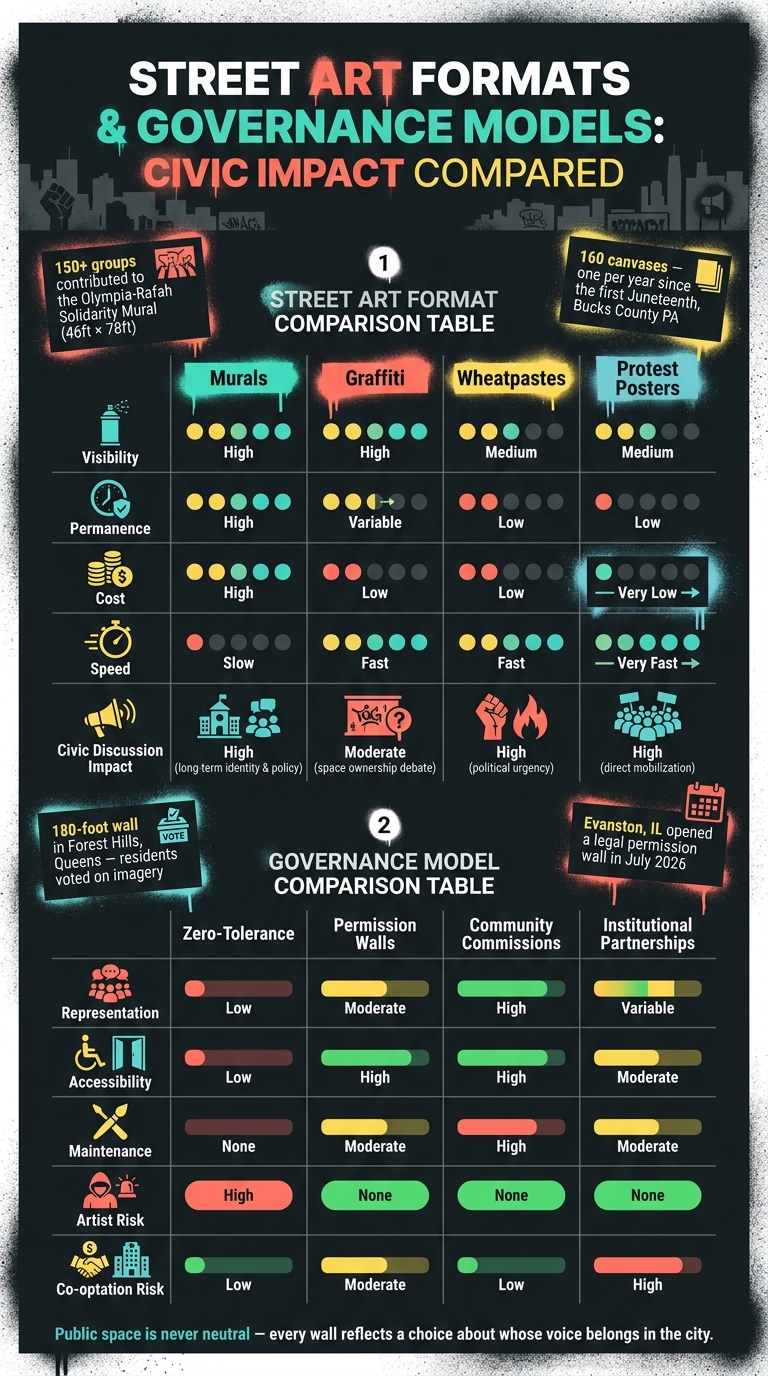
Street Art Formats vs. Governance Models: Civic Impact at a Glance
Street art doesn’t sit behind a ticket booth or inside a city meeting room. It shows up in public, right where people live and move. That public setting gives it civic force. A wall can start an argument, rally support, or put pressure on local leaders fast, without waiting for hearings or other official channels.
Political murals, stencil campaigns, and protest posters
In Olympia, WA, the Olympia-Rafah Solidarity Mural Project turned the Labor Temple wall into a 46-foot-tall by 78-foot-wide organizing tool, with contributions from more than 150 groups and individuals. The olive tree at the center became a surface for later phases of the mural, and the project still works as an organizing tool for Palestinian rights.
Wheatpastes and protest posters move at a different pace. They’re cheap, fast to make, and easy to post where people will actually notice them. That makes them useful for agitation, especially when a movement has to answer a crisis in real time.
Not all civic art comes out of activism, though. Some projects are shaped with residents from day one.
Community-led public art projects
When residents help build the work, its civic effect goes deeper. In Queens, NY, artist ErinKelli Kilbane and The Compost Collective transformed a 180-foot wall in Forest Hills through a multi-phase process. Residents voted on images such as bees and indigenous plants through Google Forms, then joined community paint days during the summer of 2024.
In Bucks County, PA, artist Kevin Aster Young worked with 16 local organizations and faith institutions in June 2024 on a Juneteenth project made up of 160 individual canvases, one for each year since the first Juneteenth. Each canvas included a QR code linking to Black history resources. Young described the approach as relinquishing control so participants could discover their own voice through the work - giving it a life the artist alone couldn't produce.
That kind of structured openness matters. A framework with room for many voices is what separates actual community participation from a mural handed down from the top.
How format shapes civic impact
The format changes the kind of public effect the work can have.
| Format | Visibility | Permanence | Cost | Speed | Civic Discussion Impact |
|---|---|---|---|---|---|
| Murals | High | High | High | Slow | High - builds long-term identity and policy discussion |
| Graffiti | High | Variable | Low | Fast | Moderate - sparks debate about public space and ownership |
| Wheatpastes | Medium | Low | Low | Fast | High - creates urgency around political and social issues |
| Protest Posters | Medium | Low | Very Low | Very Fast | High - direct agitation and mobilization |
Murals tend to last the longest, but they also take more time, money, and coordination. Wheatpastes and protest posters give up permanence for speed, which is often the right trade when people need to respond NOW. Graffiti lands somewhere else. It often pushes a different kind of public debate: not just what the message says, but who gets to claim space on a wall in the first place.
Conflict, control, and the limits of public space
When street art moves into public debate, it also runs straight into property law, city policy, and neighborhood politics. Public space may look open to everyone. In practice, ownership rules and local ordinances decide who gets to use it.
Regulation, removal, and collaboration
In Briton Ferry, Wales, a mural of Isambard Kingdom Brunel on Neath Road - a well-loved local landmark - was removed after the property owners, AJ Wilson Property Ltd, reported it as unauthorized damage. The mural had been self-funded by Councillor Gareth Rice.
Some cities take a different route and set up legal walls, giving graffiti a place in approved public space. That sounds more open, but it still depends on city permission. On one side, strict enforcement can wipe out work that a community supports. On the other, permission walls allow expression only inside rules set from above. Neither route is neutral. Both come down to a basic question: who gets to speak on public surfaces?
Those legal choices ripple outward. They affect which neighborhoods get attention from street art, which artists get room to work, and which voices are pushed aside.
Gentrification, co-optation, and representation
Street art and neighborhood change have a messy relationship. Murals and public art can bring more foot traffic, but that same attention can also speed up gentrification and push out the communities that gave the work its meaning.
The harder question is who gains when street art puts a neighborhood on the map. Who gets the paid commissions? Whose work is painted over once redevelopment starts? Who takes the money when property values climb? City-backed art can support safety plans and place branding just as much as personal expression. In Downtown Brooklyn, the Shared Streets initiative used asphalt art to slow vehicle traffic and improve pedestrian safety.
Not every group wants to work through city systems or formal arts channels. Earth Liberation Studio takes the opposite path, using Patreon and small contributions to produce agitprop.
Governance models compared
Different governance models split voice, risk, and ownership in very different ways.
| Governance Model | Representation | Accessibility | Maintenance | Artist Risk | Co-optation Risk |
|---|---|---|---|---|---|
| Zero-Tolerance | Low - unpermitted voices are erased | Low - public space is tightly controlled | None - work is removed | High | Low |
| Permission Walls | Moderate - local styles allowed within set zones | High for youth and street artists | Moderate - city oversight remains | None | Moderate - can drift toward sanitized branding |
| Community Commissions | High - rooted in local narratives and volunteer labor | High - located in everyday public spaces | High - shared participation builds stewardship | None | Low - identity stays with the neighborhood |
| Institutional Partnerships | Variable - depends on genuine participation | Moderate - often tied to city-approved spaces | Moderate | None | High - art can serve safety or redevelopment goals |
These limits shape not just what gets painted, but who gets to be part of urban culture.
Street art, access to culture, and participatory urban expression
Street art brings culture into everyday life - along school routes, at bus stops, and on the walls of corner stores - without tickets, velvet ropes, or gatekeepers. That kind of access is political. It broadens who gets to shape public culture and who gets seen inside it.
And this idea doesn’t end with murals. The image travels. It shows up on things people wear, carry, trade, and pass around.
From walls to skateboards, stickers, and apparel
Street art doesn’t stay on walls for long. A sticker, a skateboard deck graphic, or a piece of streetwear can carry that same DIY spirit into daily circulation. For a lot of young people, these mobile formats are the first step into public visual culture.
DIY formats also help artists sidestep gallery gatekeeping. And legal walls give youth a place to test style, voice, and identity without the risk of getting in legal trouble.
That same street-level visual language can shape the products and services that help local artists make a living.
How Carbonated Thoughts supports community-rooted work
Carbonated Thoughts supports community-rooted work through skateboards, streetwear, stickers, home decor, and design services tied to social and environmental causes. And every skateboard sold includes a tree planted.
Conclusion: What street art reveals about democracy
Street art makes one thing hard to ignore: public space is never neutral. Every wall that gets painted - or scrubbed clean - reflects a choice about whose voice belongs in the city. What may look like decoration is often civic participation hiding in plain sight.
Street art also makes democracy feel less abstract. It shows up in visibility. Who gets seen in public? Who gets to leave a mark? Political murals in contested neighborhoods, legal walls in Evanston, asphalt art on shared streets, and agitprop stickers on college campuses all point in the same direction: a democratic urban culture is one where people can appear on the walls, in the streets, and across the visual fabric of the places where they live.
FAQs
How is street art a form of democracy?
Street art is democratic because it takes expression out of private galleries and puts it in public space, where anyone can see it.
When it shows up on city walls, sidewalks, and other shared urban surfaces, it gives marginalized communities a visible voice. It can spark public dialogue, push back on dominant narratives, and help residents speak to local issues in plain sight. Just as important, it can bring people together around a shared sense of identity.
What makes murals different from posters or graffiti?
Murals stand apart mostly because of their purpose, their role in the community, and how long they’re meant to last. They’re often planned, community-led projects that reflect shared history, local struggles, and a sense of collective identity.
Unlike the more temporary or spontaneous nature of posters and graffiti, murals are usually intended to become lasting parts of a neighborhood and support civic participation.
Can legal walls still limit public expression?
Yes. Legal walls can make things safer for artists, but they still sit inside the rules of private property and official permission.
That matters because these spaces usually need approval from both the property owner and local authorities. So while a wall may look open to public expression, access is still limited by who says yes. Some artists, styles, or messages may be left out from the start.
Even projects built with the community in mind can be taken down if consent isn’t fully in place or if property rights are enforced. That leaves a clear tension: public expression may feel democratic, but private interests still set the boundaries.