
How Skateboarding Advocacy Supports Mental Health
Skateboarding advocacy can help mental health by giving people a place to show up, connect, and ask for help without pressure. It does not replace therapy or crisis care. But it can make support feel closer, especially for people dealing with stress, loneliness, or stigma.
Here’s the short version:
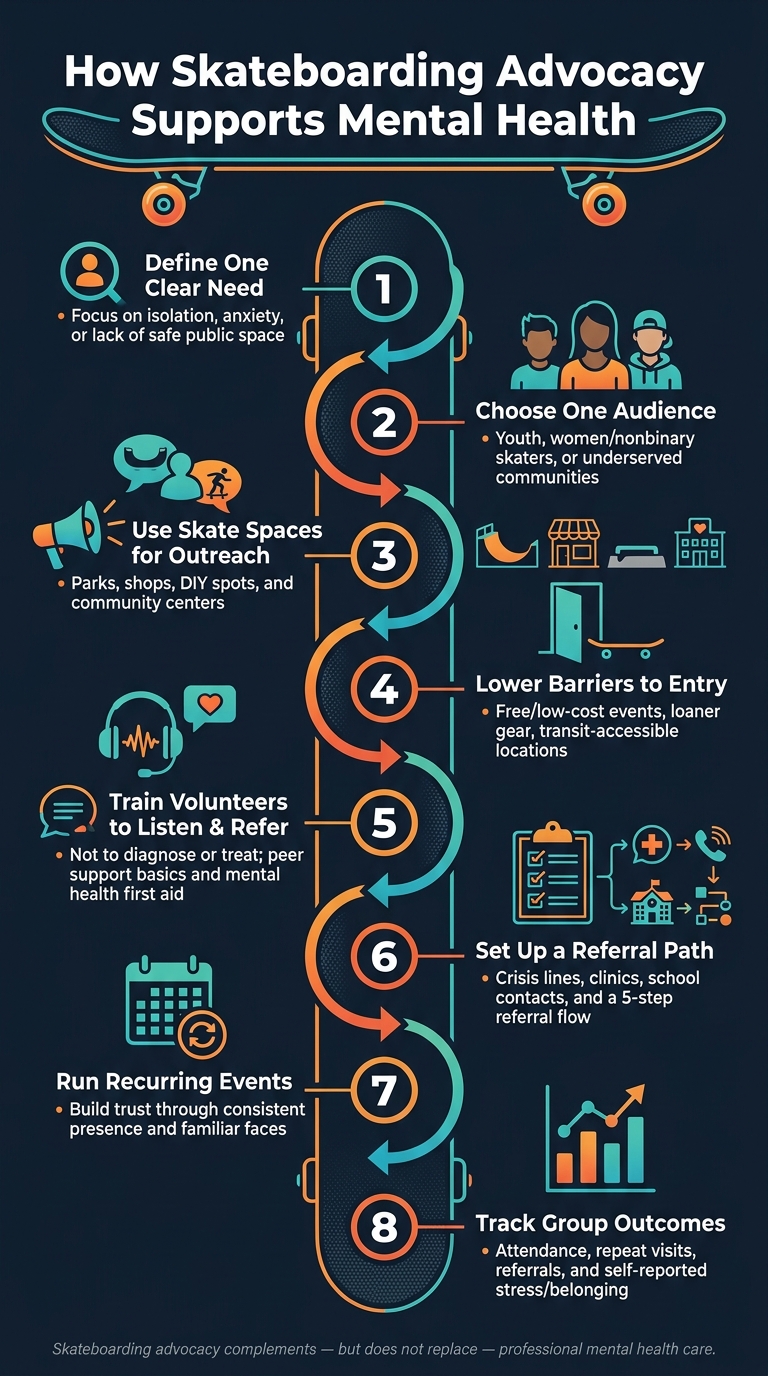
- Start with one clear need like isolation, anxiety, or lack of safe public space
- Pick one group to serve such as youth, women, nonbinary skaters, or people in under-served areas
- Use skate spaces for outreach including parks, shops, DIY spots, and community centers
- Keep events low-cost or free and offer loaner gear when possible
- Train volunteers to listen and refer instead of trying to diagnose or treat
- Set up a simple path to care with crisis lines, clinics, and school or local support contacts
- Run repeat events so people build trust over time
- Track group results like attendance, repeat visits, referrals, and self-reported stress or belonging
A few facts help explain why this works. Regular physical activity is linked to lower stress and better mood. Repeated social contact also helps people feel less alone. And for many skaters, a park or local session can feel easier to enter than a formal mental health setting.
In other words: if I want skateboarding advocacy to support mental health, I need to think beyond tricks and events. I need a clear mission, safer volunteer boundaries, low-barrier access, and a referral plan that connects people to licensed care when needed.
That’s the core idea of this article.
How to Build a Skateboarding Mental Health Advocacy Program
We Are Skateboarders: A Mental Health Transformation. - Documentary
sbb-itb-e116ef9
Build a skateboarding mental health mission
A good mission starts with a specific problem, not a broad idea. Once that need is clear, narrow the mission to one audience and one outcome. In plain English, your mission should say who you're serving and what kind of support your skate events will create.
Choose a clear audience and goal
Start by narrowing your focus. Think about who in your local skate community faces the highest barriers: youth, women and nonbinary skaters, or people in underserved neighborhoods.
After you choose your audience, tie your goal to what they actually need. If isolation is the main issue, your goal might be to increase peer connection. If stress is the bigger problem, you might focus on physical activity, peer support, and no-barrier participation.
A specific goal does two jobs at once:
- It keeps outreach focused
- It makes results easier to track
Set values for inclusion, safety, and referral
Those goals only work if the group shares clear rules for access and support. Your mission needs a few plain values that everyone can follow. Three areas matter most: inclusion, safety, and referral.
Inclusion means making it clear that everyone is welcome, with respect for every background and identity. Safety means knowing what your volunteers can and can't handle. That line matters. Volunteers should know their role is to listen, connect, and refer - not diagnose or treat.
When someone needs professional help, your team should have a clear path for connecting them with mental health resources. These values should shape who gets invited, how events are run, and when someone should be referred out.
Defining those boundaries early keeps the mission realistic and focused.
Run outreach through skateparks, skate shops, and local events
Use skate spaces as entry points for outreach
With your mission and safety values in place, take outreach into the spaces skaters already know and trust. That means skateparks, skate shops, DIY spots, community centers, and pop-up sessions.
These places do more than bring people together. They can help ease isolation, build a sense of belonging, and make it easier for someone to ask for help. A steady presence matters here. When people see the same faces over time, casual conversations can grow into trust, and mental health talks start to feel less intimidating.
Pair skating with art, music, and cause-linked events
Adding art or music to a skate event can make the whole thing feel more open and expressive. Deck design workshops, mural painting, and art tables give people an easy, low-pressure way to join in. Not everyone wants to drop in on a ramp right away. Sometimes picking up a paint marker is the easier first move.
These activities also support self-expression and can help reduce isolation. On top of that, cause-linked decks, apparel, and graphics can give an event a clear social purpose and help people feel part of something bigger than the session itself.
Lower the barrier for newcomers
Free or low-cost sessions and loaner gear can remove some of the most common reasons people stay home. Keep events beginner-friendly and open to all skill levels so no one feels like they need to prove anything before showing up.
Location matters too. Pick skateparks, DIY spots, or community centers that people can reach by public transit. The goal is simple: make the first step easy, affordable, and welcoming.
Once events feel easy to join, the next move is making sure volunteers know how to respond when someone opens up.
Train skaters and volunteers to offer basic support
Teach mental health first aid and peer-support basics
Once your events feel welcoming, the next step is simple: make sure volunteers know how to respond when someone is having a hard time.
That training should center on a few core habits: listen first, use plain language, and avoid diagnosing. Volunteers should be able to spot signs of distress like withdrawal, hopelessness, or racing thoughts. They also need to learn calm self-management and steady, grounded support so they can stay centered and help another person feel more stable in the moment.
Training on paper isn't enough. People need skills they can use right there at the park, during a session, or in the middle of a busy event. That's what turns a friendly meetup into a place where someone feels safe asking for help.
Build a simple referral path to professional care
Peer support works best when there's a clear path to outside help. Before each event, keep a short list of crisis lines, clinics, and school support contacts ready so volunteers can connect someone to care fast.
Use a simple referral flow like this:
| Referral Step | What to Do | Why It Matters |
|---|---|---|
| Immediate Response | Offer water, a quiet spot, and a calm presence | Helps stabilize the person before anything else |
| Assessment | Notice signs like withdrawal, hopelessness, or becoming unable to speak | Helps determine whether more support is needed |
| Peer Connection | Introduce them to a trained peer support worker | Builds trust and reduces stigma |
| Professional Link | Share a pre-vetted list of local counselors, clinics, or emergency contacts | Creates a safe transition to professional care |
| Follow-Up | Check in after the referral | Helps the person stay connected to the community |
When volunteers know their limits and understand the referral steps, recurring events are more likely to stay safe and consistent.
Build belonging, track impact, and share results
Run recurring events that build trust over time
Once volunteers have a clear referral path, the next step is to make the program repeatable.
Recurring meetups help trust grow over time. When people keep seeing the same faces in the same place, sessions start to feel familiar instead of intimidating. That rhythm can build confidence and a sense of belonging. It also keeps support out in the open, cuts down on isolation, and makes it easier for someone to say, "I need help."
Set a regular cadence for skate jams, volunteer days, peer-support training, and art or music collabs. Consistency also makes it much easier to track what the program is doing.
Track outcomes with a simple impact table
Keep tracking simple and anonymous so you can show change over time without putting anyone's privacy at risk. Look at attendance, repeat participation, referrals, and self-reported shifts in stress, confidence, and belonging. Brief check-ins and group-level data give partners and funders something concrete to review while protecting the people involved.
The goal is pretty straightforward: see whether the program helps people come back, connect with others, and reach support when they need it.
| Program Element | Purpose | Target Audience | Expected Mental Health Benefit |
|---|---|---|---|
| Inclusive Skate Jams | Build connection | All skaters, especially marginalized youth | Reduced isolation; increased sense of belonging |
| Peer Support Training | Set safety and referral steps | Volunteers and veteran skaters | Collective trust and efficacy; shared responsibility |
| Skill-Building Workshops | Show clear progress | Beginners and first-time participants | Increased confidence through progress |
| Community Art/Music Collabs | Lower barriers to entry | Non-skaters and local creatives | Reduced stress and anxiety; creative expression |
| Volunteer Days | Build shared purpose | Skaters and local partners | New sources of meaning and healthy hope |
Share group-level results, not individual stories.
FAQs
How is this different from therapy?
Skateboarding advocacy takes a different path from standard therapy. The focus is less on clinical care and more on peer connection, shared time, and community growth.
Instead of one-on-one sessions with a licensed professional, these programs support mental health through group experiences, mentorship, and spaces where people feel welcome. That difference matters. Advice from older skaters often hits home because it comes from lived experience, not just training.
Skating also gives people something they can feel in their body and see in their progress. You fall, get back up, try again, and slowly improve. Over time, that can help build confidence, resilience, and a stronger sense of belonging.
What training should volunteers have?
While there’s no set list of certifications here, volunteers should be ready to step in as mentors. The heart of the role is peer-to-peer guidance rooted in lived experience, not just theory.
That means showing up for young people as they work through life challenges, school, personal growth, and day-to-day skills like conflict resolution. More than anything, this kind of support depends on steady, compassionate involvement in the community.
How do you measure mental health impact?
Mental health impact shows up in the long run through positive shifts in behavior and development. That can mean better academic performance, less involvement in risky behaviors, and lower recidivism among youth.
You can also see it in day-to-day life: stronger community involvement, greater self-confidence, and the way participants deal with challenges when they have support from peers and adult volunteers.