
Raphaël Zarka: Skateboarding and Modern Art
Raphaël Zarka blends skateboarding and modern art, reshaping how we view public spaces and sculptures. Born in Montpellier, France, in 1977, Zarka is a sculptor, photographer, and skateboarding historian. His work connects ancient geometric forms, public art, and skateboarding as a physical performance. Key highlights of his career include:
- Riding Modern Art: A photo book featuring 74 images of skaters interacting with sculptures, redefining both as interconnected art forms.
- Cycloïde Piazza: A skatepark installation at the 2024 Paris Olympics, merging scientific principles with modern design.
- Zarka’s perspective: Skateboarding transforms sculptures into dynamic spaces, turning skaters into performers who interact with art.
Raphaël Zarka's Artistic Journey: From Skateboarding to Modern Art
Raphaël Zarka's Skateboarding Background
Early Years and Skateboarding Identity
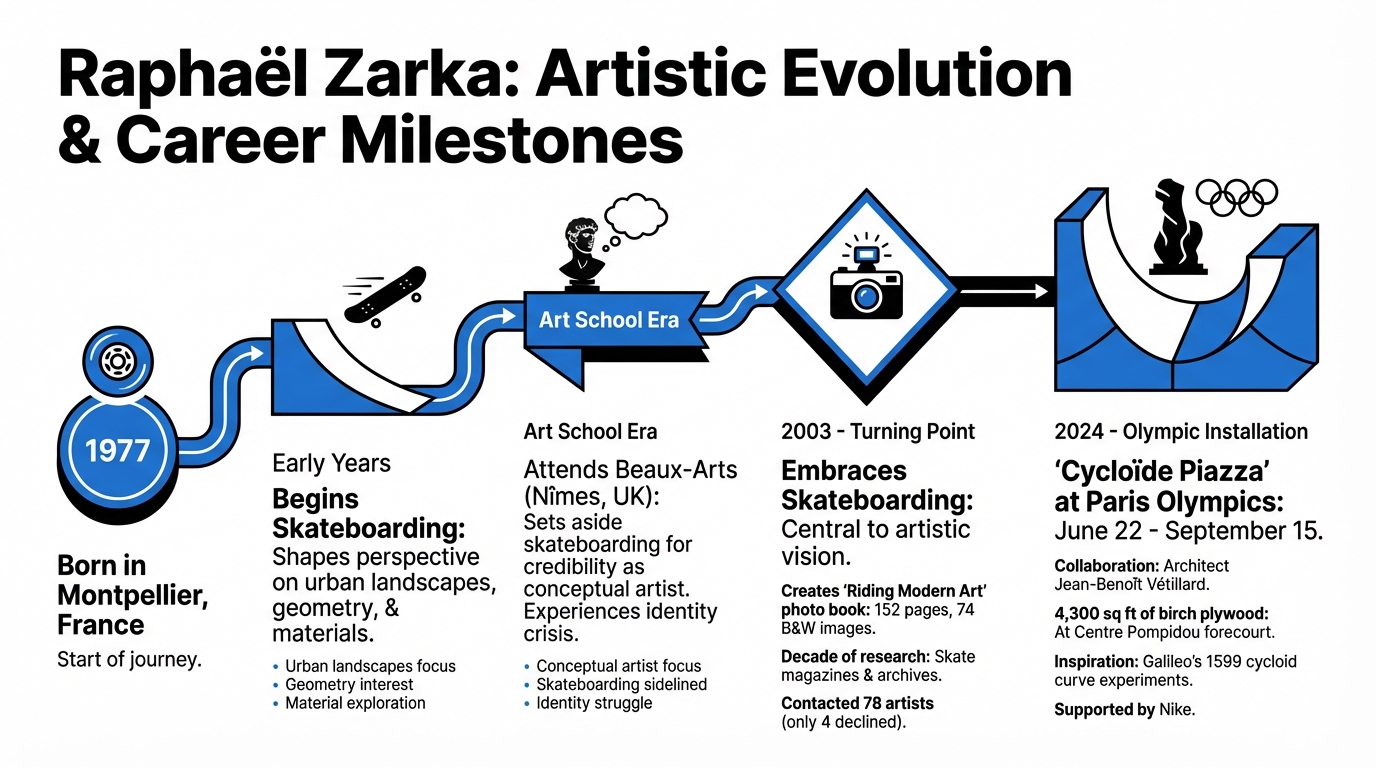
Raphaël Zarka’s journey into skateboarding began early in life, shaping not only his perspective on urban landscapes but also his understanding of geometry and materials. However, when he entered the Beaux-Arts in Nîmes and later pursued studies at an art school in the UK, he felt compelled to set aside his passion for skateboarding. At the time, the art world demanded a level of seriousness that seemed incompatible with skate culture. For Zarka, skateboarding risked undermining his credibility as a conceptual artist.
This internal conflict would later become a pivotal moment in his artistic evolution.
Bridging Skate Culture and Fine Art
Zarka’s struggle to balance his skateboarding roots with his emerging identity as an artist led to what he described as an identity crisis. He believed that in order to gain respect in the art world, he needed to suppress the very activity that had defined much of his youth and shaped his worldview.
But everything shifted in 2003. Zarka decided to stop compartmentalizing these two parts of his life and instead embraced skateboarding as a central element of his artistic vision. This decision marked a turning point. Rather than viewing skateboarding as a potential hindrance, he began to see it as a powerful lens through which to examine space, geometry, and movement. His perception of skaters evolved too. No longer were they merely urban rebels or critics of traditional art. Instead, he saw them as performers, interacting with sculptures in dynamic, almost musical ways.
"As an actor, or musician, the skater plays the piece. It's a full-on performance", Zarka explained.
This newfound perspective became the cornerstone of his work, allowing him to explore how physical movement could breathe life into static art, transforming it into something interactive and alive.
Riding Modern Art: A Photo Collection
Photo Book Overview
In 2003, Raphaël Zarka combined his passions for art and skateboarding to create Riding Modern Art, a 152-page photo book featuring 74 striking black-and-white images of skateboarders interacting with public sculptures. The idea was sparked by a Thrasher magazine cover showcasing a skateboarder on a sculpture, inspiring Zarka to present skateboarding as an art form worthy of recognition in esteemed publications like Art Forum.
Each image is meticulously captioned with the skater's name, the trick performed, the sculpture's title and year, and the artist behind it. This attention to detail turns the book into more than just a photo collection - it becomes a well-researched archive that connects the worlds of skateboarding and contemporary sculpture.
The Process Behind the Project
Zarka's vision to merge performance and sculpture required years of dedicated research. Over a decade, he scoured skateboarding magazines and online archives to gather the images that make up the collection. At times, his work felt like solving a mystery. For instance, he spent years piecing together clues - like a street name and nearby landmarks - to identify a sculpture in a photo of Jahmal Williams performing a fakie flip in Miami. He eventually confirmed it as For Miami, A Good Heart by Jean Ward.
Out of the 78 artists Zarka reached out to for permission to include their work, only four declined. To acknowledge these absences, Zarka left their pages blank except for captions, with one notable omission being sculptor Richard Serra. On the other hand, Swedish sculptor Pål Svensson, whose piece Utblick/Insikt is featured in the book, shared his thoughts:
"Personally I am proud that it is being used by a lot of people in many different aspects, as resting, sitting, skating, viewing and photographing each other... For me it means that I am on the right track."
Artistic Influences and Concepts
Skate Structures as Theoretical Inquiry
Zarka continues to merge skate culture with art, treating skateboarding as a form of theoretical exploration. He combines the physical act of skating with geometric principles, viewing the skater’s movements as representations of abstract shapes. This approach bridges the gap between art history and street culture, transforming urban landscapes into dynamic canvases for creative expression. His work naturally extends into examining how skateboarding intersects with sculpture, further enriching this dialogue.
Connections Between Skate Devices and Sculpture
Expanding on this idea, Zarka explores the relationship between skateboarding equipment and sculpture. Drawing inspiration from Aby Warburg's concept of the "survival of forms", he connects ancient geometric shapes to modern sculpture, suggesting that skateboarding brings these forms to life through playful interaction. To Zarka, skateboarding is more than a sport - it’s a "playful exploration" that critiques and reimagines architectural spaces. He describes the skateboard as a tool that animates and interacts with sculptures in ways that challenge traditional perspectives.
This view aligns with Jorge Luis Borges' remark:
"It's almost an insult to the mysteries of the world to think that we could invent anything or that we needed to invent anything".
For Zarka, spotting the potential for a backside noseblunt on a bench requires the same mindset as creating art. In this way, everyday urban objects transform into sources of unexpected artistic inspiration, revealing hidden creative possibilities within the ordinary.
sbb-itb-e116ef9
Cycloïde Piazza: A Skatepark Installation
Design and Structure
In 2024, artist Raphaël Zarka teamed up with architect Jean-Benoît Vétillard to bring Cycloïde Piazza to life - a skatepark installation crafted for the Paris 2024 Olympic Games. Spanning 4,300 square feet of birch plywood, this horseshoe-shaped structure was set on the iconic forecourt of the Centre Pompidou, a space that has previously showcased monumental works by artists like Calder, César, and Raynaud.
The design was inspired by Galileo's 1599 experiments with rolling marbles on cycloid curves, a shape he identified as the fastest path of descent [3, 19]. The installation included a vibrant blue half-pipe, quarter pipes, mini ramps, manual pads, and half-bowl stairs - all incorporating the cycloid curve into their design [17, 19]. Zarka described his vision for the project:
"The word Piazza suggests a change of scale: my sculpture was designed as a space, an area within an area, a piazza on a piazza".
Visually, the installation drew from early 20th-century Constructivism, echoing the works of artists such as Katarzyna Kobro, Lyubov Popova, Sophie Taeuber-Arp, and Sonia Delaunay. It also carried hints of the playful, bold aesthetic found in the Post-Modern design sketches of Italian architect Alessandro Mendini. This marked Zarka’s fourth major project blending skateboarding with art, supported by Nike and curated by Jean-Max Colard.
By combining the precision of scientific principles with the energy of modern art, the installation offered a fresh take on urban spaces. It became a functional sculpture where art and skateboarding could seamlessly coexist.
Temporary Exhibit and Public Response
The installation opened on June 22, 2024, and remained accessible until September 15, 2024 [19, 12]. Open daily (except Tuesdays), it transformed the Centre Pompidou’s forecourt into a lively meeting place where skateboarding, art, and culture intersected [3, 12].
Skaters of all levels, from amateurs to professionals like Oskar Rozenberg Hallberg, made use of the space throughout the summer. By placing a fully functional skatepark in such a prestigious cultural setting, the project redefined skateboarding as a form of monumental public art. As the Centre Pompidou remarked:
"Zarka invites us to re‑experiment with these curves, studied in classical mechanics, through the practice and spectacle of skateboarding" [17, 18].
This unique blend of art, science, and sport turned the installation into a vibrant urban stage, celebrating public interaction and creative expression.
Raphaël Zarka explique l'exposition RIDING MODERN ART
Conclusion
Zarka bridges the worlds of skateboarding and modern art in a way that redefines both. As a sculptor, collector, and essayist, he dissolves the boundaries between art history and urban subculture, illustrating how geometric forms - from Plato’s ideals to modernist designs - find fresh life in skateable structures. In his view, the skateboarder isn’t merely an observer but a performer, bringing sculpture to life through motion.
Through this blend of art and action, Zarka reimagines the role of public art. His projects, such as Riding Modern Art and Cycloïde Piazza, transform static installations into stages for dynamic performance. By doing so, he turns overlooked or forgotten structures into vibrant spaces of interaction and movement.
What sets Zarka apart is his embrace of subcultural identity to deepen artistic expression. By adopting the concept of the "open form", where art becomes a setting for human interaction and engagement, he demonstrates how spaces can be inclusive, functional, and visually striking all at once. His work challenges us to see every curve, edge, and surface as a potential arena for creativity and motion.
This seamless fusion of art and skate culture aligns perfectly with the spirit of Carbonated Thoughts, where innovation meets urban creativity. Explore more bold intersections of art and skate culture at https://carbonatedthoughts.store.
FAQs
How does Raphaël Zarka combine skateboarding and modern art?
Raphaël Zarka merges skateboarding with modern art by crafting geometric sculptures specifically designed for skating. These pieces are more than just art - they're functional installations that invite skaters to engage with them, turning their movements into a living, dynamic form of artistic expression.
In addition, Zarka captures skaters using public monuments as their playgrounds, reinterpreting these static landmarks as ever-changing canvases. By doing so, he transforms skateboarding into a performance art, seamlessly blending creativity and motion while redefining how public and artistic spaces can interact.
What makes the Cycloïde Piazza installation special for the Paris 2024 Olympics?
The Cycloïde Piazza is a one-of-a-kind skateable public sculpture designed for the Paris 2024 Olympics. Situated on the forecourt of the Centre Pompidou, it reimagines the space as a vibrant hub for urban activity. This striking creation merges modern art, geometric design, and skateboarding culture, offering an engaging experience that’s both visual and interactive, all as part of the Games’ cultural programming.
Celebrating the connection between art and skateboarding, this installation encourages visitors to explore it in both physical and visual ways, making it a memorable highlight of the Olympic festivities.
Why did Raphaël Zarka feel torn between skateboarding and art?
Raphaël Zarka found himself grappling with a tension between two parts of his life: his passion for skateboarding and his ambitions as a professional artist. Concerned that his connection to skateboarding might harm his reputation in the art world, he chose to step back from the sport for a while. This allowed him to concentrate fully on establishing himself and earning respect for his artistic endeavors.