
WhaT IS THE POINT OF RELIGION?
Religion is evolving, not disappearing. While fewer Americans attend services or identify with organized faith, spirituality finds new forms in urban culture. Religious imagery appears in streetwear, skateboarding, and art, while interfaith efforts tackle societal issues like homelessness and environmental challenges. Faith-based organizations still provide critical services - 60% of homeless shelter beds and 73% of U.S. charitable donations come from religious groups. Younger generations, though less tied to institutions, continue to seek meaning, often blending spirituality with modern life.
Key Takeaways:
- Decline in traditional participation: Weekly service attendance dropped from 35% in 1975 to 22% in 2022.
- Rise of "nones": 30% of Americans claim no religious affiliation, up from 5% in 1970.
- Faith in action: Religious groups lead in healthcare, housing, and social justice initiatives.
- Urban spirituality: Sacred symbols reappear in streetwear, skateboarding, and reimagined spaces like the Kaos Temple skate park.
- Interfaith collaboration: Communities unite to address shared challenges, bridging divides through action.
Religion remains relevant by adapting to urban life, inspiring art, fostering community, and addressing pressing needs.
The Problems: Religion in Cities and Secular Spaces
Fewer People Attending Religious Services in Cities
In the U.S., the number of people attending religious services weekly has seen a sharp decline - from 35% in 1975 to just 22% in 2022. At the same time, the share of Americans who rarely or never attend has doubled, climbing from 22% to 44% over the same period. The COVID-19 pandemic only intensified this trend, with monthly attendance dropping from 33% in 2019 to 30% in 2022. Among Black Protestants, the decline was especially steep, falling 15 points from 61% to 46%.
Urban design plays a role here, as cities built around cars and suburban sprawl make it harder to sustain traditional worship practices. Aidan Kavanagh, O.S.B., a monk and Yale Divinity Professor, captured this shift in urban priorities:
"The center gave way to parking lots and bus stops; discourse fractured... and the sovereign individual was relegated to suburban sprawls focused on the centers of consumption called shopping malls."
This car-centric model disrupts large-scale religious events like processions, public rituals, and gatherings, which once thrived in walkable, community-focused spaces.
Adding to this is the "achievism" culture, which prioritizes material success and individual autonomy over communal or spiritual commitments. Jonathan Abbamonte, a Policy Analyst at The Heritage Foundation, explains:
"Religion often becomes personally less important in life when society no longer recognizes its importance and no longer practices it publicly."
When faith is reduced to a private matter, the shared motivation to attend services disappears, weakening both participation and the communal ties these gatherings once reinforced.
Weakened Identity and Community Bonds
As religious participation declines, urban communities lose a key element of their social cohesion. Between 2010 and 2015, the loss of religious affiliation translated to 10 million fewer volunteers. Additionally, individuals with religious ties donate significantly more to charitable causes - $1,590 annually on average, compared to $695 among those without such affiliations.
Modern urban life has also fostered a phenomenon known as "civil disattention", where people actively avoid connecting with one another. Discussions around urban renewal often sideline religious perspectives, further diminishing a sense of shared identity. Meanwhile, former houses of worship are being converted into apartments, cinemas, and commercial spaces, removing the physical landmarks that once served as hubs for community values and relationships.
These shifts highlight the need to rethink how urban culture might reinterpret religious symbols and spaces to create new forms of connection and shared meaning.
sbb-itb-e116ef9
The Solutions: Religion as Creative Fuel in Urban Culture
Religious Imagery in Streetwear and Skateboarding
Urban culture has found a way to weave religious symbolism into its artistic tapestry. Christian streetwear brands like Faith Mode and God Is Dope transform clothing into both a statement and a platform for faith. Bold designs and scripture-inspired slogans, such as "Hell Hates Me" or "Holy Rebel", make their apparel stand out as wearable declarations of belief. Jerry Lorenzo, the mind behind the streetwear label Fear of God, captures this connection perfectly:
"My faith informs everything I do. For the brand, it gives us reason. Reason to speak, purpose in how and why we communicate."
Even social media has embraced this blend of faith and fashion. The Instagram account PreachersNSneakers, which highlights the intersection of ministry and streetwear, gained an impressive 162,000 followers just two months after its debut.
Skateboarding, another cornerstone of urban culture, has cultivated its own spiritual undertones. Icons like Jay Adams and Mark Gonzales are revered as though they were saints, forming a kind of "pantheon" in the skateboarding world. Certain skate spots are treated as sacred spaces - visiting them feels like a pilgrimage to "hallowed ground". Even the boards themselves often feature religious imagery, using symbols like devils and crucifixes to provoke, parody, or honor. Within this culture, rituals such as landing a first kickflip or dropping in for the first time are celebrated as rites of passage, creating a secular but deeply meaningful spiritual framework.
This fusion of faith and urban expression has also inspired projects that breathe new life into sacred spaces.
Case Study: The Kaos Temple Project
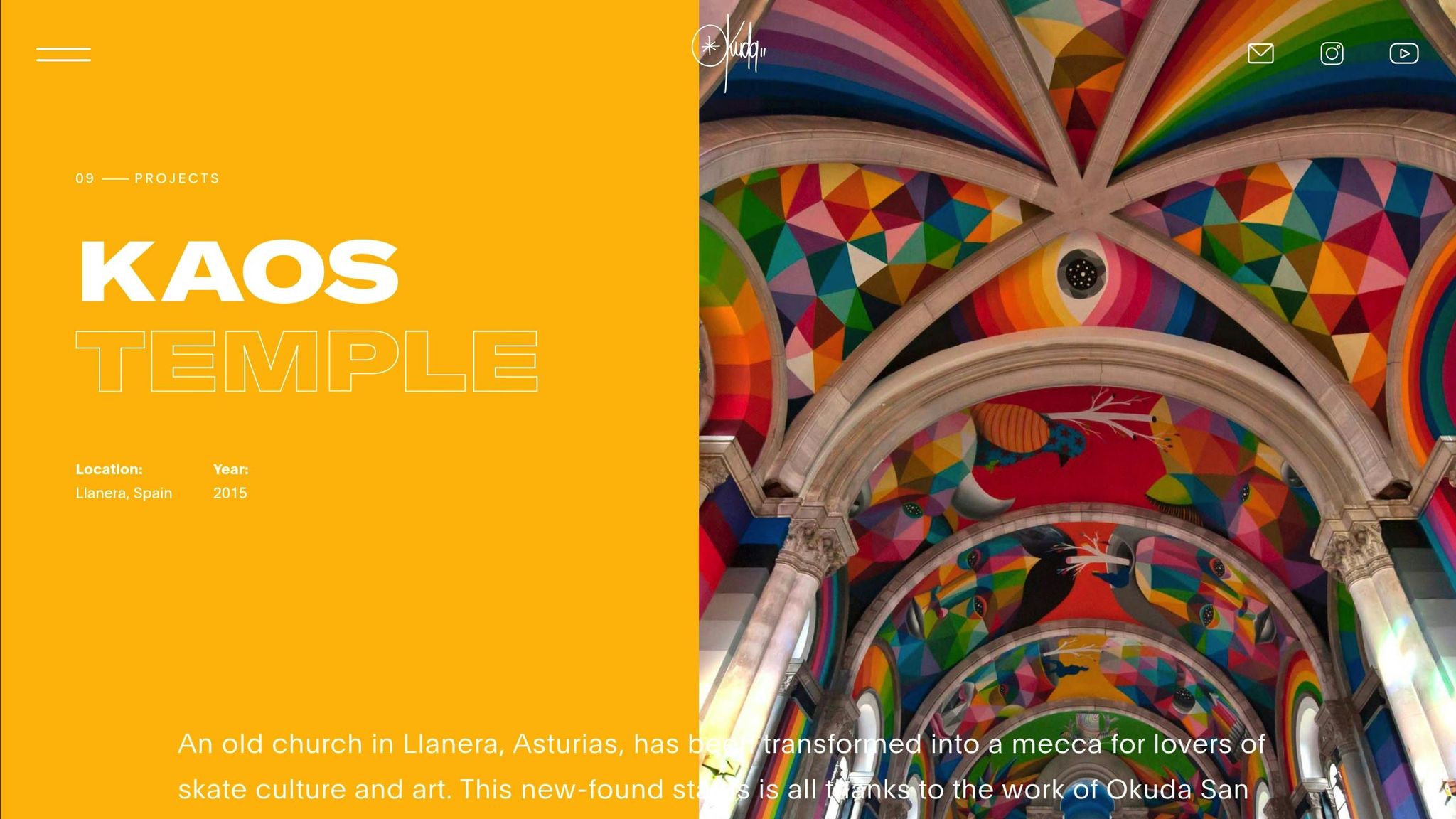
For a striking example of this intersection, look no further than the Kaos Temple Project. In December 2015, artist Okuda San Miguel transformed the abandoned Church of Santa Barbera in Llanera, Spain, into an indoor skate park bursting with color and creativity. With support from Red Bull and the Church Brigade skate crew, the project reimagined the 100-year-old Romanesque revival building. Its vaulted ceilings now feature geometric murals and vibrant rainbow-colored skulls, giving the space an entirely new identity.
The initiative was no small feat - it raised over $25,000 through crowdfunding and online donations to bring the vision to life. Okuda himself explained the unique harmony between the two seemingly different worlds:
"I fell in love with the place, because both concepts [church and skate park] were so right together... The icon of the Kaos Temple is three positive symbols: +++."
Once abandoned following the Spanish Civil War, the church has now become a sanctuary of a different kind - a place where skaters, artists, and visitors can come together to celebrate movement, creativity, and community.
Religion for Building Communities and Driving Social Change
Interfaith Conversations and Shared Worship Spaces
Urban communities are finding new ways to bridge faith divides - not through endless debates, but by rolling up their sleeves and working together. Take Utica, New York, for example. Here, an interfaith board of Jews, Christians, and Muslims tackled lead paint poisoning in older buildings that disproportionately affected low-income residents and communities of color. They also created community gardens to restore damaged neighborhoods. These efforts reflect a broader trend of reimagining sacred spaces as hubs of collaboration and creativity.
Following the October 7, 2023, attacks, interfaith prayer vigils brought Muslims, Jews, and Christians together in cities like Rochester, Buffalo, Detroit, and Palo Alto to pray for peace in the Middle East. As S. B. Rodriguez-Plate, a Religious Studies professor at Hamilton College, observed:
"Just showing up for each other at these critical times - it can't be overstated how important that is."
Interfaith work often goes beyond words. It’s about shared experiences - singing together, linking arms, and immersing in the sounds and scents of different traditions. Ruth Braunstein, a Sociology professor at the University of Connecticut, highlights this dynamic:
"The goal of such practices is not to deny differences, but rather to focus attention on what participants share, including an appreciation of their differences."
This spirit of unity naturally extends to tackling larger social and environmental challenges.
Religion in Social and Environmental Movements
Religious organizations often play pivotal roles in addressing urgent social and environmental issues. For instance, in 2020, the Arizona Faith Network launched the Extreme Heat Cooling Center project in Phoenix, running eight cooling centers to help residents during the sweltering heat season. Faith-based groups also provide around 40% of healthcare services in sub-Saharan Africa, showcasing their ability to meet critical needs.
On a global scale, the Global Interfaith WASH Alliance brings together imams, swamis, and priests to address water, sanitation, and hygiene issues. They’ve tackled menstruation taboos and worked to clean local rivers, aiming to reduce disease and poverty. In India, the Swachh Bharat Abhiyan campaign, supported by groups like Islamic Relief and Eco Sikh, tied sanitation improvements to religious teachings, leading to the construction of nearly 90 million toilets.
Faith traditions also inspire direct action. On June 4, 2020, the Sikh Center of New York distributed meals to support racial justice protesters, drawing on the Sikh practice of langar (community kitchen). Sadhvi Bhagawati Saraswati, a Vedic monk and author, captures the essence of such efforts:
"Faith shouldn't be about how we attain heaven after death - it should be about how we create heaven on earth."
Carbonated Thoughts' Social Impact Work

Creative ventures, much like faith-based initiatives, are proving they can make a difference. Carbonated Thoughts blends artistic expression with environmental action. For every skateboard sold, the company plants a tree, directly contributing to reforestation. Their design and branding services start at $55 per hour, while business consulting is available at $100 per hour, helping others build brands centered on social causes.
Rooted in skateboarding culture and the energy of streetwear, Carbonated Thoughts embodies a modern form of urban spirituality. By combining art, skate culture, and meaningful social impact, this initiative mirrors the way faith-based groups transform urban spaces into hubs for justice and environmental progress. It’s a fresh example of how creativity and purpose can intersect to drive real change.
We Are Brothers, Skateboarders, Americans, and Muslims
Comparison Table: Traditional Religion vs. Urban-Adapted Spirituality
Traditional Religion vs Urban-Adapted Spirituality Comparison
Traditional Religion vs. Urban-Adapted Spirituality
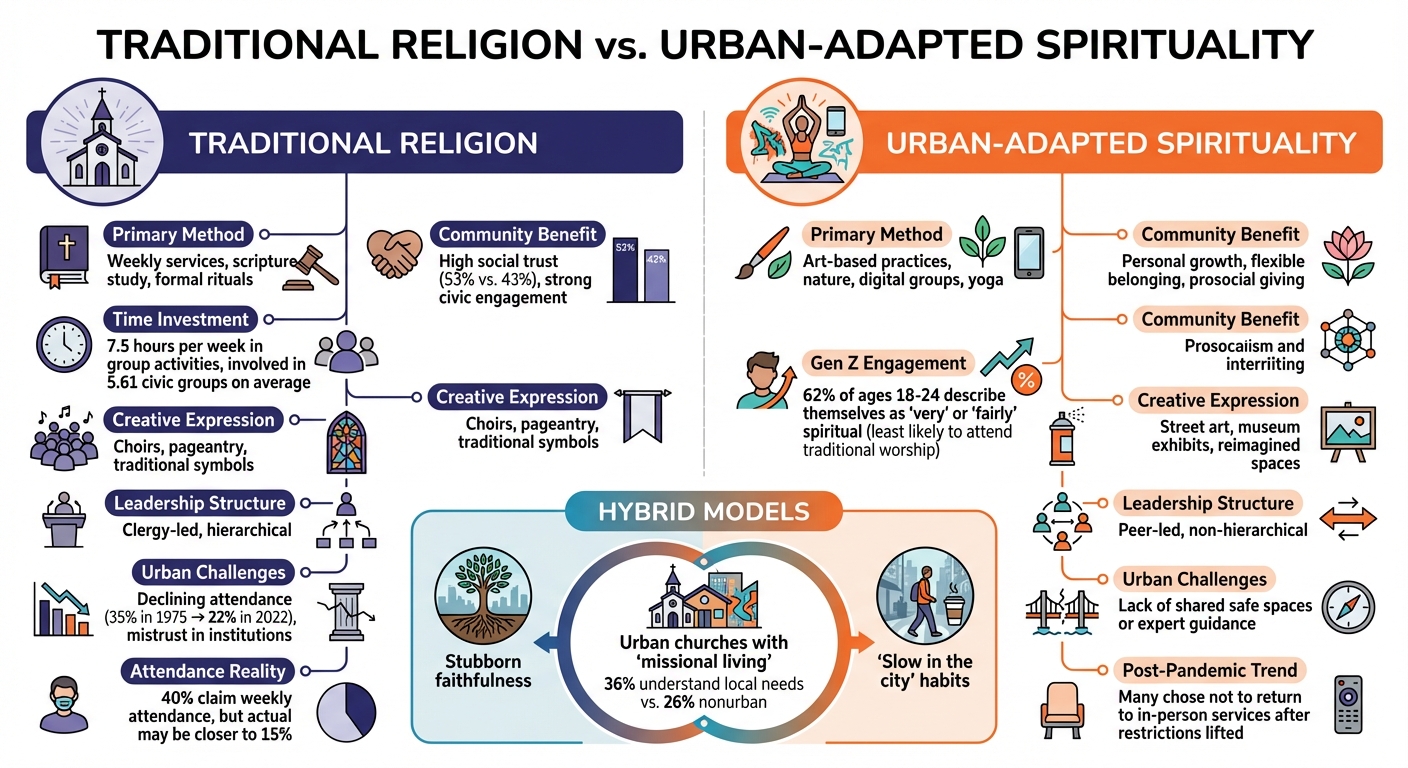
As urban life reshapes how people connect and find meaning, faith practices have split into two distinct paths: traditional religion and urban-adapted spirituality. These approaches reflect the changing ways individuals engage with spirituality in modern cityscapes.
Traditional religion leans on established practices like weekly worship services, scripture study, and rituals led by ordained clergy. In contrast, urban-adapted spirituality offers a more individualistic approach, often embracing creative outlets and digital platforms without the structure of formal institutions.
The numbers highlight this divergence. While 40% of Americans have historically claimed weekly religious attendance, actual participation might be closer to 15%. On the other hand, 62% of Gen Z (ages 18–24) describe themselves as "very" or "fairly" spiritual, yet they are the least likely to attend traditional worship spaces. The pandemic further accelerated this trend, with many choosing not to return to in-person services after restrictions lifted.
The two approaches cater to different needs and offer distinct experiences. For instance, religiously active Americans spend an average of 7.5 hours per week in group activities and are involved in about 5.61 civic groups. Urban-adapted spirituality, however, thrives in flexible, peer-led communities, such as street art collectives or online meditation groups, where traditional hierarchies are absent.
Here’s a side-by-side look at how these two models differ:
| Feature | Traditional Religion | Urban-Adapted Spirituality |
|---|---|---|
| Primary Method | Weekly services, scripture study, formal rituals | Art-based practices, nature, digital groups, yoga |
| Community Benefit | High social trust (53% vs. 43%), strong civic engagement | Personal growth, flexible belonging, prosocial giving |
| Creative Expression | Choirs, pageantry, traditional symbols | Street art, museum exhibits, reimagined spaces |
| Urban Challenges Addressed | Declining attendance, mistrust in institutions | Lack of shared safe spaces or expert guidance |
| Leadership Structure | Clergy-led, hierarchical | Peer-led, non-hierarchical |
Some communities are blending these approaches, creating hybrid models that combine traditional elements with urban innovations. For example, urban churches often emphasize "missional" living, with 36% of attendees saying they understand local needs, compared to 26% in nonurban churches. These groups embrace what they call "stubborn faithfulness", committing long-term to neighborhoods and adopting "slow in the city" habits to counter the fast-paced, transient nature of urban life.
As Karina Kreminski, a lecturer and author, provocatively asks:
"Can you imagine a local faith community intentionally living out an urban spirituality that forms that community into missionaries?"
This evolving landscape of spirituality highlights how faith continues to adapt and influence life in urban environments.
Conclusion: Why Religion Still Matters
Main Points
Faith is finding fresh expression within urban culture. Today, sacred symbols are being reinterpreted through art, fashion, and personal style. Despite shifting trends since 1998, a significant 62% of 18- to 24-year-olds still describe themselves as "very" or "fairly" spiritual. Rather than turning away from spirituality, Gen Z is reshaping it in ways that resonate with modern life.
From streetwear to viral fashion trends, sacred imagery has become a tool for self-expression and building community identity. As artist Noella aptly states, "Religion is art when done right". Beyond aesthetics, faith communities are tackling real-world challenges, providing 60% of emergency shelter beds for the homeless and accounting for 73% of all charitable donations in the U.S..
Some religious groups are also transforming neglected urban spaces into vibrant multi-use hubs that meet both spiritual and social needs. Initiatives like the Nuns and Nones residency and Mockingbird Hill House are breaking new ground with intergenerational models of activism and community building. Brie Loskota from USC's Center for Religion and Civic Culture highlights how these efforts breathe new life into old traditions, "infusing those things with new meaning and relevance".
These examples show how religion continues to evolve, offering opportunities for creativity and practical impact in urban communities.
Next Steps
Urban spirituality is a growing force, and it may hold untapped potential for your own creative endeavors. Whether you’re designing streetwear, reimagining public spaces, or launching a social project, exploring the connection between faith and urban culture can provide inspiration. At Carbonated Thoughts, we help creators bring meaningful projects to life - whether it’s skateboard designs tied to social causes or consulting services that align brands with deeper values.
Take a moment to consider the sacred spaces in your neighborhood. Could they serve as platforms for art, activism, or community engagement? Adam Horowitz, co-founder of Nuns and Nones, captures this potential beautifully: "The lived taste of being in community across age and faith traditions makes me even more keen to orient my life toward making it manifest more often and for more people". Religion remains relevant because it continues to inspire creativity, foster connections, and drive positive change in the places we call home.
FAQs
Is religion being replaced by spirituality?
The connection between religion and spirituality is shifting in noticeable ways. A growing number of Americans, particularly younger people, describe themselves as "spiritual but not religious." They lean toward personal practices like meditation or embrace symbols such as crystals. While organized religion continues to hold significance for many, spirituality is often viewed as a more individual and adaptable approach. Rather than completely replacing traditional religious structures, spirituality tends to either complement them or reshape them, especially in modern, urban settings.
Why is religion showing up in streetwear and skate culture?
Religion finds its way into streetwear and skate culture as a powerful tool for expressing identity, personal beliefs, and even social critique. In streetwear, religious symbols are often intertwined with urban aesthetics, creating bold designs that speak to individuality or build a sense of belonging. Skateboarding takes a similar approach, weaving spiritual themes into its art and culture to emphasize self-expression and push back against conventional norms. Together, these cultures use religious imagery to explore deeper spiritual ideas while forging connections among urban youth.
How can faith groups still matter if fewer people attend church?
Faith groups continue to stay meaningful by shifting their focus to meet modern needs and prioritizing community and connection. With traditional church attendance on the decline, many are reimagining their roles by creating inclusive spaces that emphasize social activism, shared values, and expressions like art and community-building. These initiatives provide people with a sense of belonging, purpose, and support, proving that faith communities can flourish in ways that extend beyond traditional worship practices.