
Public Art and the U.N. Sustainability Goals
Public art is becoming a powerful way to connect people with the U.N.'s Sustainable Development Goals (SDGs). These goals, introduced in 2015, aim to address global challenges like poverty, inequality, and climate change by 2030. However, communicating these complex ideas effectively has been a challenge. Public art - murals, sculptures, and installations - offers a visual and emotional way to engage communities, spark conversations, and inspire action.
Key examples include Philadelphia's SDG mural project, which pairs 17 murals with grants for local nonprofits, and Villanova University's campus mural promoting responsible consumption. Other initiatives, like Ibrahim Mahama's work with reclaimed materials, blend art with social impact, while projects like "CityTrees" use technology to address urban challenges. These efforts highlight how art can make global goals more relatable and actionable for everyday people, especially in cities where most of the world's population now lives.
Highlights:
- Philadelphia SDG Murals: 17 artworks paired with $3,000 grants for nonprofits, raising awareness across the city.
- Villanova University: A campus mural tied to local food security efforts, engaging students and faculty.
- Ibrahim Mahama: Large-scale installations using reclaimed materials to critique global trade and inequality.
- CityTrees: Interactive urban installations combining art and environmental solutions.
Public art creates a bridge between global challenges and local communities, offering a fresh way to engage with sustainability goals.
1. Global Philadelphia SDG Mural Project
Scale and Scope
Philadelphia has embraced public art as a way to promote awareness of the United Nations' Sustainable Development Goals (SDGs). The initiative features 17 murals, each representing one of the SDGs. These 10x10-foot murals, painted on movable canvases, are displayed in locations like universities, parks, and schools before coming together for a special exhibition in 2026. By April 2025, 16 of the murals had already been installed across North, West, and South Philadelphia. The strategic placement of these artworks is bolstered by strong community involvement.
Community Engagement
The project goes beyond art - it directly supports the SDGs through a unique grant model. Each mural installation is paired with a $3,000 grant awarded to a local nonprofit whose mission aligns with the specific SDG depicted. To date, over $50,000 has been distributed to organizations working on sustainability initiatives.
In November 2023, 17-year-old artist Faysal Adger unveiled his mural for SDG #8 (Decent Work and Economic Growth) at the School of the Future in West Philadelphia. His artwork portrays community members harvesting apples with the help of drones and robots, symbolizing a harmonious relationship between people and technology. Sponsored by TEACHERS&, this mural also facilitated a $3,000 grant to the Economy League of Greater Philadelphia. Reflecting on his work, Faysal Adger shared:
"I wanted to show people and technology working together toward a better future", emphasizing the importance of economic growth and community collaboration in driving sustainability.
Artistic Medium and Sustainability
The murals feature a mix of artistic styles, from literal representations to abstract interpretations, sparking curiosity and dialogue about sustainability. For instance, in October 2022, Penn graduate student Eliza Nobles completed "The Four Elements" for SDG #7 (Affordable and Clean Energy) at the FDR Park boathouse. Her mural highlights wind, solar, hydroelectric, and geothermal energy through four symbolic figures, set against a backdrop of the power grid. Cornelia Colijn, Executive Director of the Kleinman Center for Energy Policy, commented:
"Eliza's painting will serve as a reminder of the urgent need for a clean energy transition and the balance that can come when we achieve that goal".
Each mural installation includes a plaque with a QR code, allowing viewers to access educational materials about the SDG and the artist's vision. This approach enhances the project's educational value and broadens its impact.
Impact on SDG Awareness and Action
The murals are more than just art - they’re tools for education. The Global Philadelphia Association provides free, downloadable lesson plans for educators to teach students about the SDGs. Zabeth Teelucksingh, President of the Global Philadelphia Association, explained:
"We intend for all 17 works to be in one location, collectively, so that Philadelphians can go back and visit and better understand why the SDGs are important to the city".
2. Villanova University SDG Posters
Scale and Scope
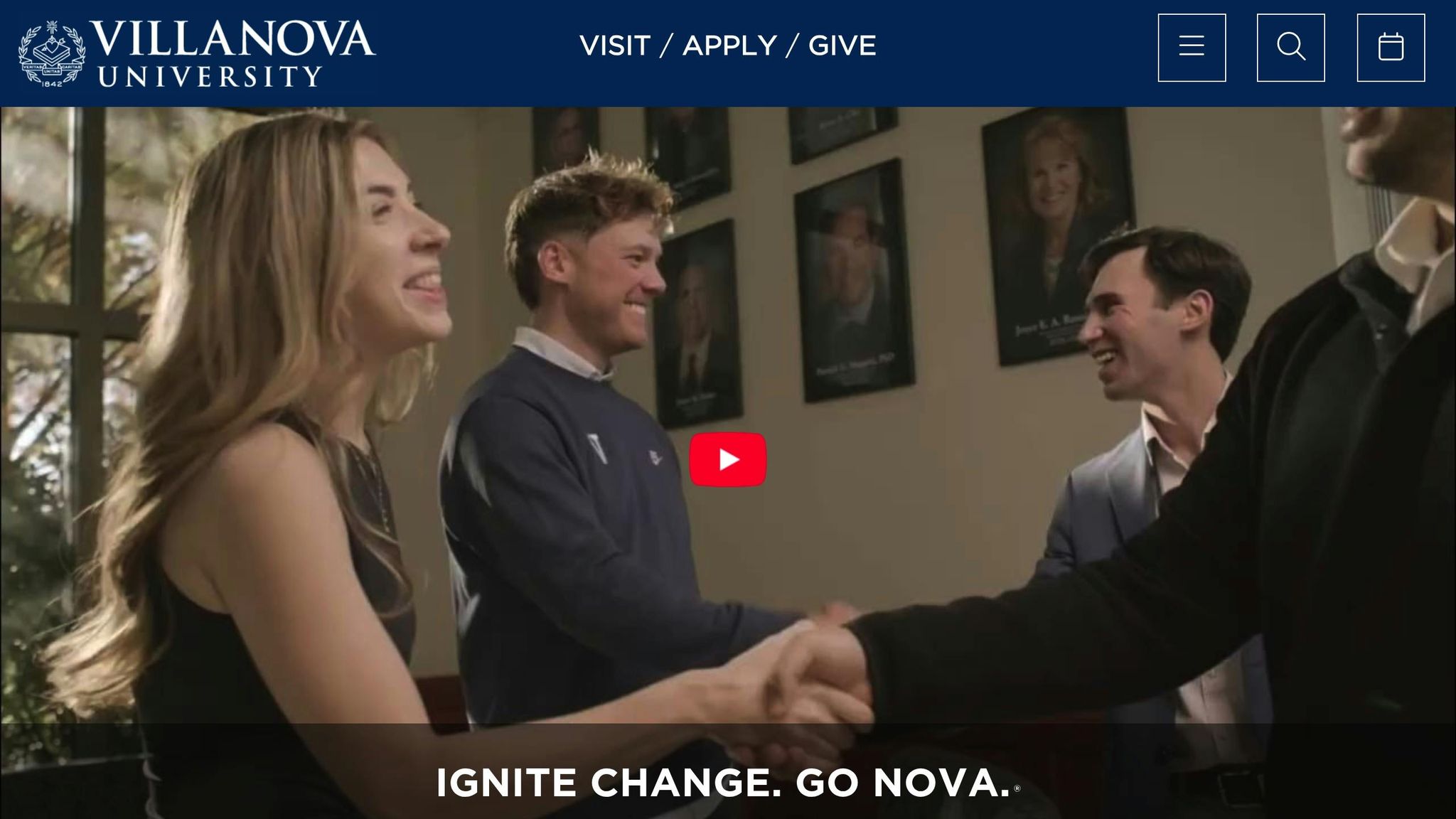
Villanova University has shown how public art can inspire communities to work toward the United Nations' sustainability goals. In November 2024, the university joined a city-wide SDG mural campaign, focusing on SDG #12: Responsible Consumption and Production. Partnering with the Global Philadelphia Association, Villanova installed a mural on the highly visible exterior of the Connelly Center. The piece, created by Maggie Hobson-Baker, an Assistant Teaching Professor in Studio Art, emphasizes humanity's role as "active guardians" and "stewards" of the environment. This mural serves as a starting point for broader conversations about sustainability across the campus.
Community Engagement
The project brought together various departments, including Sustainability, Global Leadership, Nursing, Engineering, Business, and Liberal Arts. The mural's unveiling on November 13, 2024, featured President Donohue and Sarah Petrus '25, sparking discussions about environmental responsibility among students and faculty.
The initiative also provided tangible support to the community. Through an established grant model, the project awarded $3,000 to Martha's Choice Marketplace & Community Farm, a local organization that distributes over 2 million pounds of food annually to more than 15,000 people in Montgomery County. This financial backing ties the artistic effort directly to addressing local food security and promoting sustainable consumption.
Impact on SDG Awareness and Action
The mural's central location on campus transforms it into a permanent educational resource. Rob McNeill, Board Chair of the Global Philadelphia Association, praised the initiative, saying:
"I can think of no better place to amplify this message of sustainability than Villanova University. I applaud Villanova's efforts to utilize this beautiful piece of art as a tool for education, inspiration and the promotion of a more sustainable future for our planet".
This project aligns with Villanova's commitment to the Laudato Si' Action Platform, reflecting the university's Augustinian values of Unitas, Veritas, and Caritas. As Pennsylvania's oldest and largest Catholic university, Villanova uses this artwork to reaffirm its dedication to environmental stewardship and global responsibility.
3. City as Living Laboratory Initiatives
Scale and Scope
Building on the success of city-scale SDG murals, the Living Laboratory initiatives take sustainability to the streets, literally. These projects turn urban spaces into real-time testing grounds for environmentally conscious public art. For example, the CityTrees project, which has been installed in cities like Glasgow, Oslo, Paris, and Hong Kong, showcases how art can adapt to various urban climates while addressing environmental challenges. Unlike traditional "smart city" approaches, these initiatives weave art and culture into the fabric of urban planning, creating spaces that are not only functional but also socially, culturally, and ecologically resilient. By introducing dynamic, sustainability-focused interventions, these projects push the boundaries of urban design.
Community Engagement
What makes these initiatives stand out is their deep commitment to community involvement. Using Community-Based Participatory Research (CBPR), they engage local residents at every stage - identifying challenges, brainstorming solutions, and crafting the final artwork. Co-creation workshops bring together artists, community members, and key stakeholders to ensure that the installations resonate with the area's unique culture, history, and aspirations. This hands-on approach transforms residents into active participants, empowering them to shape how their neighborhoods align with U.N. sustainability goals.
Artistic Medium and Sustainability
These projects also embrace cutting-edge technologies like IoT, AI, and edge computing to create responsive installations that interact with their surroundings in real time. The result? Art that not only tells a story but also reacts to environmental data, fostering a deeper connection between people and their urban environments. These installations tackle sustainability from all angles: they promote environmental awareness through interactive displays, encourage social inclusion and celebrate cultural diversity through participatory design, and boost local economies by drawing tourists and supporting the creative sector. In essence, they turn cities into living, breathing works of art that inspire and engage.
4. Ibrahim Mahama's Found Material Projects
Scale and Scope
Ibrahim Mahama is known for transforming large-scale structures to explore themes like labor, history, and global trade. In April 2019, his installation A Friend covered the Porta Venezia tollgates in Milan with reclaimed jute sacks. This "second skin", as Mahama describes it, invites viewers to confront the hidden histories of colonialism and the labor tied to global commerce. Another notable work, A Straight Line Through the Carcass of History 1649, was the centerpiece of Ghana's first pavilion at the 58th Venice Biennale in 2019. This piece tackled the decline of post-independence industrial infrastructure. Through these monumental works, Mahama not only reshapes physical spaces but also sparks conversations about societal transformation.
Community Engagement
Mahama’s art extends beyond aesthetics, focusing on creating meaningful change within his community. He reinvests earnings from his international art sales into local initiatives, notably the Savannah Centre for Contemporary Art (SCCA) in Tamale, Ghana. Established in 2019, this privately funded art and research center serves as a hub for education and creativity. His installations often involve collaboration with local communities, highlighting the challenges of navigating global systems of inequality. As Mahama puts it:
The point is to use the contradictions of the flow of capital in the art world to create spaces in Ghana that can eventually affect the material values within artistic practice and inspire the imagination of generations yet to emerge.
Artistic Medium and Sustainability
Mahama’s commitment to sustainability is evident in his reuse of materials like jute sacks, which he incorporates into multiple projects worldwide. These materials, often tied to historic trade routes, gain deeper meaning through repeated use. Mahama also repurposes industrial remnants, such as abandoned railway parts and colonial-era wooden grills, transforming them into contemporary art that critiques historical legacies. His work aligns with global goals like reducing inequality (SDG 10) and building sustainable communities (SDG 11), while challenging Western-centric interpretations of art. As he explains:
I think the West needs to start learning how to read forms beyond their physical appearance.
sbb-itb-e116ef9
Through public art, the U.N. sustainability goals come to life
Strengths and Weaknesses
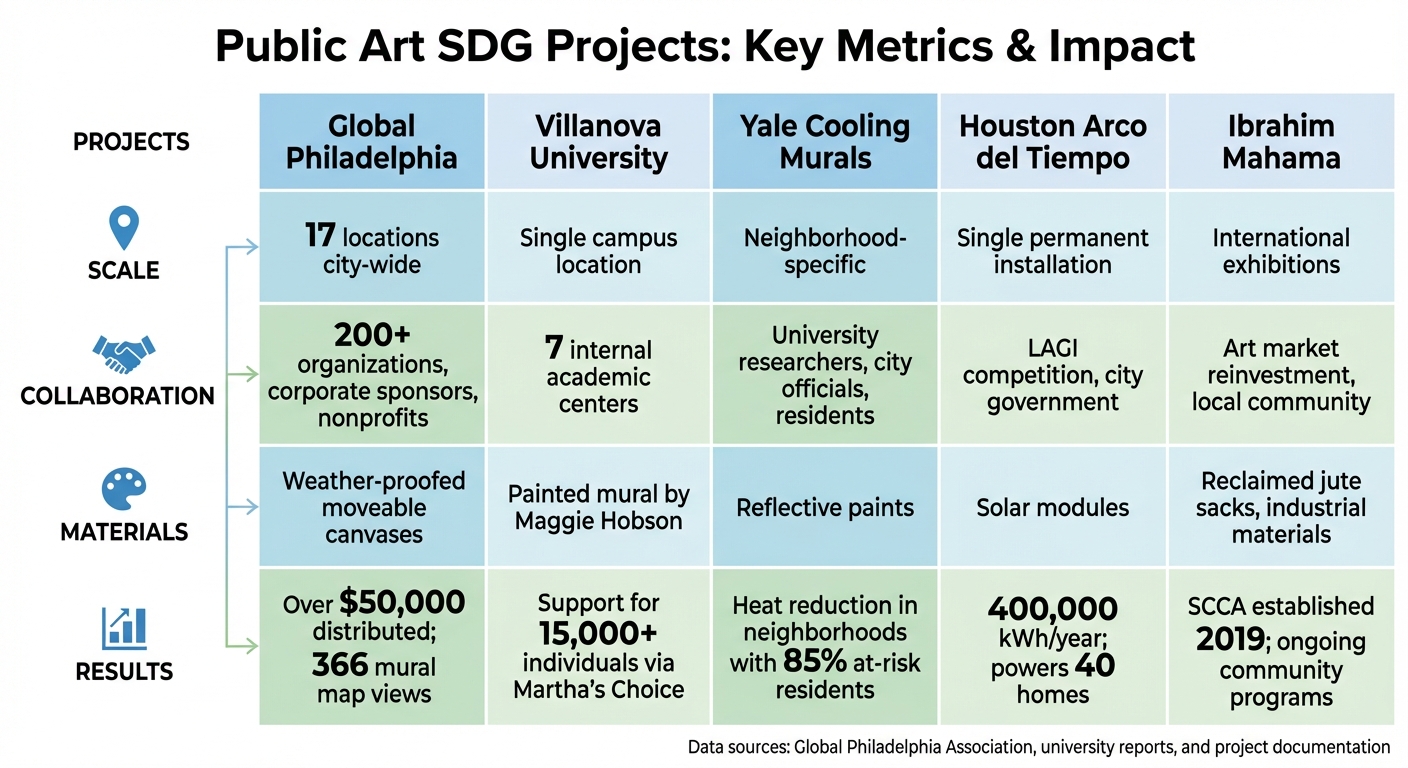
Comparison of 5 Major Public Art SDG Projects: Scale, Impact and Results
Let’s take a closer look at the strengths and challenges of these initiatives in advancing the U.N. Sustainability Goals (SDGs). Each project brings unique contributions but also faces specific hurdles.
The Global Philadelphia Association’s initiative, for instance, has a broad reach, with 17 murals spread across the city - each representing an SDG. This effort connects with both locals and tourists, while providing over $50,000 in grants to local nonprofits. However, the use of weather-proofed, moveable canvases means ongoing maintenance is necessary, and their temporary nature may limit long-term community impact. In contrast, Villanova University focuses on its academic community of over 10,000 students, promoting collaboration through seven academic centers. While impactful on campus, its influence doesn’t extend far beyond the university.
Other projects, like Yale’s Cooling Murals, tackle urban heat risks in vulnerable neighborhoods. These murals use reflective paints to reduce heat in areas where 85% of residents face extreme heat risk. As Professor Karen Seto highlights:
Cool murals have the potential to educate, inspire and empower communities to create hyper local climate solutions and can be scaled to other cities.
However, the effectiveness of reflective paints is limited to surfaces like roofs and pavements. Similarly, Houston’s Arco del Tiempo generates 400,000 kWh annually - enough to power 40 homes. But this impressive output requires significant upfront investment and technical expertise.
On a global scale, Ibrahim Mahama combines art and sustainability by reusing industrial materials like jute sacks in his exhibitions and through the Savannah Centre for Contemporary Art (SCCA). Street artist Bill Posters describes the power of street art:
Street art… is a weapon in the struggle against oppression, social and environmental injustice and conformity… forms of art that manifest creative forms of resistance to the multiple threats of climate change.
Yet, as researcher Susan Hansen points out, there are environmental concerns tied to street art projects, particularly those involving international travel and aerosol paints:
the environmental and health impact of organized street art-based initiatives - especially those that involve international travel and the use of environmentally damaging aerosol paint - should be considered.
Here’s a breakdown of key projects and their measurable contributions:
| Project | Scale | Collaboration Method | Primary Materials | Measured Results |
|---|---|---|---|---|
| Global Philadelphia | 17 locations city-wide | 200+ organizations, corporate sponsors, nonprofits | Weather-proofed moveable canvases | Over $50,000 distributed; 366 mural map views |
| Villanova University | Single campus location | 7 internal academic centers | Painted mural by Maggie Hobson | Support for 15,000+ individuals via Martha's Choice |
| Yale Cooling Murals | Neighborhood-specific | University researchers, city officials, residents | Reflective paints | Heat reduction in neighborhoods with 85% at-risk residents |
| Houston Arco del Tiempo | Single permanent installation | LAGI competition, city government | Solar modules | 400,000 kWh/year; 40 homes powered |
| Ibrahim Mahama | International exhibitions | Art market reinvestment, local community | Reclaimed jute sacks, industrial materials | SCCA established 2019; ongoing community programs |
The balance between temporary and permanent installations significantly impacts each project’s legacy. Philadelphia’s moveable murals, for example, are destined to be consolidated into a single SDG gallery by 2026, coinciding with the U.S. Semiquincentennial celebrations. This approach showcases adaptability and future planning. Meanwhile, Houston’s Arco del Tiempo reflects a long-term investment in renewable energy. While projects focused on functionality deliver measurable environmental benefits, those driven by artistic expression often excel in sparking dialogue and cultural engagement within communities.
Conclusion
Public art plays a crucial role in advancing the U.N. Sustainability Goals within urban spaces. The most impactful projects combine community involvement, measurable ecological contributions, and diverse funding sources to ensure their longevity. When residents actively participate in the creation process, it strengthens urban sustainability efforts. Additionally, eco-sculptures have shown tangible environmental benefits, such as improving air quality through natural filtration systems.
Despite these successes, cities - while occupying just 3% of the Earth's surface - are responsible for 75% of global carbon emissions. Public art initiatives often face challenges like fragmented planning frameworks, insufficient maintenance funding, and the difficulty of balancing eco-friendly materials with durability. As Susan Hansen of Middlesex University London notes:
Visual forms of communication about sustainability issues are a powerful means of synthesizing complex information, portraying new ideas, prompting thought and dialogue, and rapidly conveying ideas.
Yet, this potential often goes untapped when art is treated as an afterthought in urban development.
To maximize its impact, art must be integrated into the early stages of urban planning rather than added later. The "sustainably smART" framework provides a clear strategy, focusing on inclusivity, simplicity, scalability, policy-driven momentum, and measurable outcomes. Collaboration between artists, scientists, and urban planners is also essential to address the environmental challenges cities face today. For example, intelligent design practices have already reduced carbon emissions to 0.24 kg CO2e/h. Lessons from cities like Philadelphia and Villanova highlight the importance of scaling successful pilot projects into broader city-wide initiatives. Achieving this requires strong political commitment and sustained funding.
Platforms like Carbonated Thoughts (https://carbonatedthoughts.store) showcase how art can inspire both environmental and social progress, offering a glimpse into the transformative potential of public art in shaping sustainable urban futures.
FAQs
How does public art raise awareness about the U.N. Sustainable Development Goals?
Public art takes the ambitious themes of the U.N. Sustainable Development Goals (SDGs) and turns them into something people can see, feel, and connect with. By weaving ideas like clean energy, gender equality, and climate action into murals, sculptures, and interactive installations, it breaks down these complex topics into experiences that resonate with everyday life.
Take murals, for instance. A city-wide mural campaign can visually interpret all 17 SDGs, encouraging people to explore and discuss the goals as they encounter the artwork. Then there are interactive installations - imagine displays that use real-time data, like air quality readings or solar energy outputs, to show sustainability in action. These installations don’t just inform; they demonstrate progress in ways you can see and understand.
In this way, public art doesn’t just decorate a space - it sparks conversations, builds community connections, and inspires action. It’s a creative way to bring the SDGs out of policy documents and into the streets, where they can truly make an impact.
How do community grants support public art projects that align with the U.N. Sustainability Goals?
Community grants play a key role in funding public art projects that focus on sustainability in urban areas. Take the Asphalt Art Initiative, for example. It provides grants of up to $100,000 per city to create large-scale, street-level artworks. These projects are designed to make public spaces safer, more welcoming, and accessible to everyone. They directly support SDG 11 (Sustainable Cities and Communities) and SDG 16 (Peace, Justice, and Strong Institutions). Many of these grants also include technical guidance and impact assessments to ensure the projects deliver real, measurable benefits to the communities they serve.
Another example is Bloomberg Philanthropies’ Public Art Challenge, which awards up to $1 million for temporary art installations that tackle urban challenges like climate action or promoting cultural inclusion. These grants encourage collaboration between public and private sectors while boosting local economies, aligning with SDG 8 (Decent Work and Economic Growth) and SDG 13 (Climate Action). By funding these initiatives, community grants help reimagine urban spaces as hubs for learning, connection, and meaningful conversations about sustainability.
How are technologies like IoT and AI being used in public art to support sustainability?
Public art is taking a bold step forward with the integration of technologies like the Internet of Things (IoT) and artificial intelligence (AI). These innovations are turning traditional static artworks into interactive and responsive installations that contribute to sustainability efforts. By embedding IoT sensors, QR codes, and Bluetooth beacons into public art, creators can gather real-time data on visitor engagement, foot traffic, and even environmental conditions like air quality. This information is invaluable for urban planners, helping them assess the social and environmental impact of these installations. Additionally, features like adaptive lighting and kinetic designs can reduce energy consumption, aligning with goals such as affordable clean energy and sustainable cities.
AI takes this a step further by analyzing the collected data to create designs that respond to their surroundings. For instance, AI-driven installations can adapt to changes in weather, crowd density, or noise levels - helping to create a calming atmosphere, minimize heat absorption, or encourage environmentally friendly behaviors. These advancements not only align with the United Nations’ sustainability objectives but also demonstrate how public art can actively contribute to climate solutions while enhancing the vibrancy of urban spaces.