
How Murals Inspire Local Eco Action
Murals are transforming cityscapes into platforms for action on climate challenges. They don’t just beautify neighborhoods - they educate, connect, and engage communities in addressing issues like urban heat, biodiversity loss, and air pollution. Key takeaways:
- Art Meets Science: Projects like New Haven's 2024 mural use cooling paint to combat heat islands while raising awareness about global warming.
- Local Impact: Incorporating local species, landmarks, and stories makes climate issues relatable, as seen in Sacramento’s Southside Park mural.
- Community Involvement: Collaborative efforts, such as California’s Climate Art Trail, bring people together to create art while sparking conversations about local challenges.
- Tangible Benefits: Some murals go beyond messaging, contributing directly to urban solutions like temperature reduction and waste recycling.
Murals stand out because they’re accessible, visible, and capable of turning abstract problems into personal, actionable ideas. By combining art, science, and community, they offer a powerful way to inspire change in urban spaces.
Street Wise Mural Festival 2024: Murals for the Environment
sbb-itb-e116ef9
How Murals Deliver Environmental Messages
Murals have a unique way of connecting with people during their daily lives. Unlike digital campaigns or indoor exhibits, these large-scale artworks turn urban walls, transit hubs, and tunnels into open-air classrooms, seamlessly blending into the rhythm of city life. This constant visibility ensures that environmental messages grab attention, especially in high-traffic areas. Let’s explore how public spaces amplify these messages and make them resonate.
Using Public Spaces to Raise Environmental Awareness
Murals thrive in public spaces by reaching audiences who might never step into a museum or read a scientific report. A great example is Martín Ron’s 2022 mural in Houston, Texas. Towering 16 stories high, it depicts an African American woman holding an oak branch and addresses "tree equity" - the idea that underserved communities often lack tree cover, which is crucial for health and cooling in urban areas. By placing this artwork on a prominent building, the message about environmental justice became part of the city's daily dialogue.
The urgency of such messages is clear when considering the staggering toll of air pollution, which claims over 8.1 million lives annually and affects 99% of the global population. Low-income communities bear the brunt of this crisis. Murals in these neighborhoods do more than raise awareness - they validate the struggles of those living there, making environmental issues feel personal and immediate. Through bold visuals, these artworks communicate complex ideas in seconds, making them both impactful and accessible.
Visual Storytelling in Eco Murals
The power of murals lies in their ability to tell intricate stories through striking imagery. In September 2022, Carlos Alberto unveiled a mural at New York City's Javits Center during Climate Week. The piece depicted biodiversity loss with extinct species like the dodo on one side and recovering species like the panda on the other. This single image conveyed the potential for ecosystem restoration in a way that words often cannot.
When communities are involved in choosing imagery that reflects their local identity, the murals take on even greater meaning. These personal connections can inspire action. As Henry Walsh puts it:
"Narrative creates responsibility. When people see a story they recognize - a local fox raising kits or native plants feeding pollinators - they feel implicated in the species' future".
For instance, in 2025, artist Vesod created "N6tur3", a 4,000-square-foot mural at Twickenham Stadium in London. The artwork highlighted the importance of freshwater ecosystems to both historical and modern urban life, focusing on the rivers that shaped London’s development. By linking the past to the present, the mural encouraged viewers to see their role in protecting these vital waterways.
Some murals go beyond storytelling and provide tangible environmental benefits. Take New Haven's Dixwell mural, which uses cooling paint technology to reflect UV rays, reducing surface temperatures and combating the urban heat island effect. This innovation turns murals into active contributors to climate solutions, combining art with function in a powerful way.
Community Participation in Mural Projects
When locals come together to create a mural, it becomes more than just art - it reflects their neighborhood's values and priorities. This hands-on approach helps turn broad issues, like climate change, into something relatable and grounded in the community's reality. These projects merge artistic expression with environmental awareness, creating a meaningful connection between the two.
Collaborative Creation for Greater Impact
Involving the community from the start changes everything. Take the California Climate Art Trail, for example. In September 2023, this initiative kicked off with a mural painted on a barn in a 9,000-tree almond orchard in Davis. Spearheaded by project leaders Mike Russell and Steve Shaffer, and in partnership with UC Davis, the project included a community paint day led by muralist Leon Willis. Using a paint-by-numbers system, more than 250 participants - ranging from toddlers to seniors - helped create a mural showcasing climate-resilient crops and restored wetlands. The method ensured that anyone, regardless of artistic ability, could contribute.
This kind of inclusive participation does more than produce art. As UC Davis Professor Emily Schlickman noted:
"People were excited about the art, but it also sparked conversation about what we can do".
Painting together naturally fosters discussions about local environmental challenges and solutions in a way that feels approachable and immediate. These collaborations also amplify local voices, making the artwork deeply personal and reflective of the community.
Amplifying Local Voices Through Art
Murals often become a voice for the people. In New Haven’s Dixwell neighborhood, for instance, artist Mike DeAngelo held workshops to ensure the mural design resonated with locals. Residents selected imagery that felt familiar, such as garden insects, utility poles, and neighborhood landmarks. Community Research Assistant Nadine Horton explained:
"Climate change is a big concept... It's not always top of mind here because the immediate thought in neighborhoods like ours is, I just want to make sure my family's taken care of. So you have to reflect the neighborhood itself".
In Martinez, California, young people played a central role in creating a mural unveiled in March 2026. Around 150 residents attended the event, which celebrated the collaborative work of the Boys & Girls Clubs of Contra Costa and artist Tim Hon from the Illuminaries collective. Hon highlighted the mural’s purpose:
"We wanted young people to see this mural and know that they have something to offer, that they can express themselves, affect change, and do what they love".
The unveiling, sponsored by MCE - an organization that has invested over $2.3 million in clean energy programs in Martinez - showed how murals can inspire the next generation to view environmental action as achievable and personally relevant.
Examples of Eco-Focused Murals
Case Studies of Impactful Eco Murals
Across the United States, eco-focused murals are transforming urban spaces while encouraging environmental awareness and action. In October 2024, Yale University collaborated with New Haven to unveil a mural that incorporated cooling paint technology designed to reflect UV radiation and reduce urban heat. This initiative also introduced the Mural Apprenticeship Program, which trains local artists, extending the project's influence beyond the mural itself. Daniel Pizarro, Yale Climate Engagement Fellow, shared his thoughts on the community's response:
"It sparked folks' creative imaginations in ways that I didn't expect. Everyone was excited about the potential of what this could provide to the Dixwell community".
Other cities have also embraced the fusion of art and environmental innovation. In July 2025, Albany, New York, took a creative approach by repurposing leftover paint for a mural at the Quackenbush Garage. Local artist Quill Harrison partnered with PaintCare and the Albany Parking Authority to highlight the staggering 85 million gallons of household paint that go unused annually in the U.S. The mural not only reduced waste but also underscored the importance of recycling. Sean Palladino, Executive Director of the Albany Parking Authority, remarked:
"This latest mural at Quackenbush is another example of our continued commitment to serving the City of Albany while supporting local artists and community partners in the process".
Moving westward, Sacramento showcased another inspiring example in May 2024 at the Southside Park Community Garden. Led by PhD student and Earth Scholar Heather Lieb, the mural project was supported by a $5,000 award from the UC Davis Institute of the Environment. As part of the California Climate Art Trail, the mural brought together local volunteers to address Sacramento's air quality challenges. Lieb emphasized the importance of engaging youth in climate activism:
"Climate change will be this generation's biggest challenge and inspiring youth through activism and art will create momentum as they move into the workforce".
Art and Commerce: Platforms Supporting Eco Art
These projects show how murals can inspire environmental action, but platforms are also emerging to sustain eco-focused creativity. One example is Carbonated Thoughts (https://carbonatedthoughts.store), which ties commerce to environmental causes. The platform offers products like skateboards, apparel, stickers, and home decor, often linked to social and environmental themes. For every skateboard sold, the store plants a tree, creating a direct connection between purchases and restoration efforts. Additionally, it provides design and business consulting services, empowering artists and activists to turn their creative visions into actionable, sustainable projects.
Challenges and Solutions for Maintaining Mural Influence
Pros and Cons of Using Murals for Environmental Messaging
Balancing Temporary Art with Long-Term Impact
Murals can grab attention instantly, but keeping their impact alive over time is no small task. Weather conditions like UV rays, rain, and temperature swings, along with vandalism, can wear down their appeal. That’s where community involvement steps in to make a real difference.
When communities take ownership of murals, they shift from being passive admirers to active caretakers. Cities have seen success by organizing local volunteers to maintain specific murals, from cleaning to touch-ups. This not only preserves the art but also builds a sense of pride and connection. Another creative approach is pairing murals with green spaces - like pollinator gardens or bioswales - which amplifies their message about environmental care.
Technology also plays a key role. Tools like QR codes and augmented reality can turn static murals into interactive experiences. For example, they can link viewers to live conservation updates or citizen science platforms like iNaturalist. This digital layer keeps the mural’s message fresh and relevant, even as its physical condition changes over time. A mix of community efforts and tech innovations can help murals remain powerful tools for urban environmental awareness.
Comparison Table: Pros and Cons of Murals for Eco Messaging
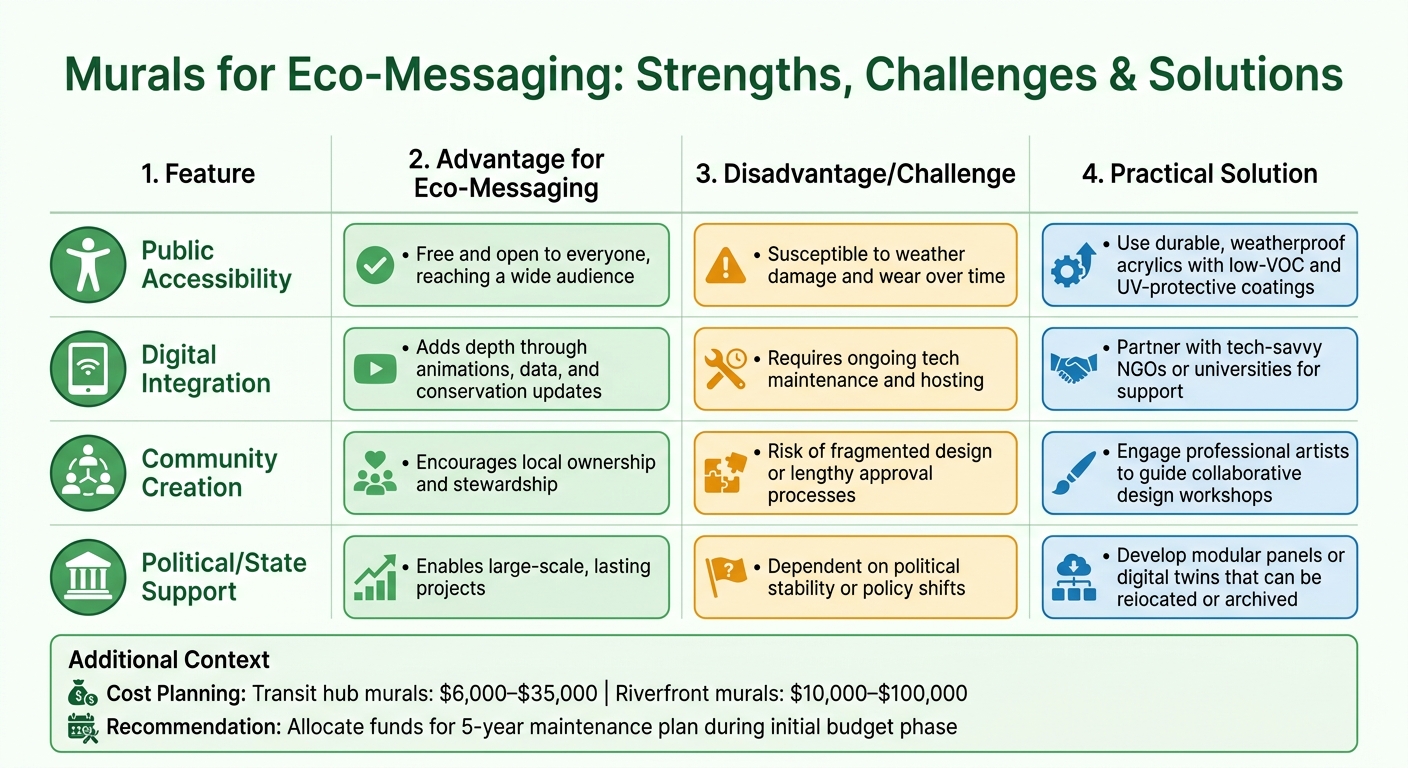
Here’s a breakdown of the strengths and challenges of using murals for eco messaging, along with practical solutions to address the hurdles:
| Feature | Advantage for Eco-Messaging | Disadvantage/Challenge | Practical Solution |
|---|---|---|---|
| Public Accessibility | Free and open to everyone, reaching a wide audience | Susceptible to weather damage and wear over time | Use durable, weatherproof acrylics with low-VOC and UV-protective coatings |
| Digital Integration | Adds depth through animations, data, and conservation updates | Requires ongoing tech maintenance and hosting | Partner with tech-savvy NGOs or universities for support |
| Community Creation | Encourages local ownership and stewardship | Risk of fragmented design or lengthy approval processes | Engage professional artists to guide collaborative design workshops |
| Political/State Support | Enables large-scale, lasting projects | Dependent on political stability or policy shifts | Develop modular panels or digital twins that can be relocated or archived |
Planning ahead is crucial. Allocating funds for a 5-year maintenance plan during the initial budget phase can save headaches down the road. For context, murals at transit hubs typically cost $6,000–$35,000, while larger-scale riverfront murals can range from $10,000 to $100,000.
Conclusion
Murals do more than just brighten up neighborhoods - they bring pressing issues, like climate change, into focus in ways that feel personal and urgent. By featuring elements like local wildlife, iconic landmarks, or everyday scenes, these artworks bridge the gap between abstract global crises and the realities of daily life. Through community involvement, green infrastructure, and even digital tools like QR codes, murals inspire viewers to take action.
The examples shared, from New Haven to Sacramento, highlight how these projects go beyond aesthetics. They show how murals can spark real environmental engagement while enhancing the spaces they inhabit. Platforms such as Carbonated Thoughts play a vital role by connecting artistic projects with funding and resources aimed at sustainability, proving that art and environmental action can work hand in hand.
Looking ahead, the success of eco-murals depends on community ownership, sustainable materials, and ongoing digital interaction. When neighborhoods embrace these artworks as part of their identity and tie them to tangible environmental efforts - like creating pollinator gardens or restoring watersheds - murals evolve into something lasting. They become more than just art; they turn public spaces into dynamic arenas where creativity meets environmental progress.
FAQs
How can my neighborhood start a community eco-mural?
To kick off a community eco-mural project, begin by bringing together neighbors who share an interest in the idea to form a planning group. Pick a prominent spot, such as a park or a well-trafficked community wall, to ensure the mural catches attention. Focus the design on environmental themes that resonate with the group and encourage participation.
Plan a painting day where residents can join in, making it a collaborative effort. You might also reach out to local schools or community organizations for supplies, funding, or additional hands to help. Once the mural is complete, host a celebration to showcase the artwork. This not only highlights the community’s efforts but also inspires future environmental initiatives while fostering stronger neighborhood connections.
Do eco-murals actually reduce heat or pollution?
Eco-murals coated with surface-cooling materials can reduce surface temperatures by as much as 30%, offering a way to combat the urban heat island effect. That said, there isn't concrete evidence to suggest they have a major impact on lowering overall air pollution or greenhouse gas levels.
How do you keep a mural’s impact going long-term?
To keep a mural meaningful over time, it's essential to maintain community engagement and connect it with activities like workshops or cleanup events. Regular touch-ups or updates can help the artwork stay fresh and relevant. Additionally, leveraging digital platforms and social media can broaden its audience. By blending artistic expression with hands-on involvement and educational efforts, the mural's message can continue to resonate and inspire.