
How Artists Use Tech for Skateboard Installations
Skateboarding is evolving into an art form fueled by technology. Artists now use motion sensors, projection mapping, drones, and 3D printing to transform tricks into visual and physical creations. These installations turn skateparks into interactive spaces where every move generates dynamic visuals, sound, or even blockchain-based collectibles. Key examples include:
- Motion Tracking and Sculptures: Paul Ferragut's system records skate tricks, converting them into 3D-printed sculptures.
- Projection Mapping: "Philly Radness" used sensors to create real-time visuals reacting to skaters’ movements.
- Drone Art: Dave Bachinsky’s drone-captured loops preserved on blockchain connect physical and digital worlds.
- Public Installations: Projects like Mark Igloliorte’s Saputiit and Alexis Sablone’s Candy Courts integrate skateboarding into urban spaces while celebrating community and design.
Artists face challenges like durability, safety, and public acceptance but continue to push skateboarding into new realms by blending performance with interactive art.
The Growth of Technology in Skateboard Art
What Are Interactive Skateboard Installations?
Interactive skateboard installations merge skating with cutting-edge technology, creating art that reacts to movement in real time. Unlike static displays, these installations require active participation, transforming skate tricks into a dynamic mix of visuals and sound.
Take the "Philly Radness" installation at Drexel University's Leonard Pearlstein Gallery in April 2016, for example. Created by Eric Cade Schoenborn and skateboarder Ed Selego, this project turned a skatepark into a living canvas. As they put it:
"We turned life into an animated GIF and skated it".
The setup used sensors to track skaters' movements, generating evolving patterns of digital art with every trick performed.
These installations stand apart from traditional skateparks, which prioritize functionality over form. A great example of this difference is Leif Hauge's "Tempos", installed at Chinatown Courts in Boston in October 2021. Instead of smooth concrete, "Tempos" featured modular structures with unique textures like diamond grind patterns and colonial brickwork. These surfaces provided sensory feedback to skaters while doubling as public art. The modular design also allowed for reconfiguration, offering endless creative opportunities for both skaters and spectators. This blend of physical motion and digital interaction is redefining skateboarding as a form of cultural expression.
How Technology Changed Skateboarding Culture
Beyond installations, technology has reshaped skateboarding into a vibrant intersection of art and urban life. Before the digital boom, skateboarding art relied heavily on traditional mediums like filming and photography. Now, it’s evolving into something more permanent - turning fleeting tricks into digital sculptures and even blockchain-based collectibles.
A standout example is Dave Bachinsky's "Roll Forever" project. Using drone photography, he captured 50 pool lines and transformed them into seamless digital loops, preserved on the blockchain.
"I think the future is going to be digitally connected. That's where we're all headed and it's just early days," Bachinsky remarked.
The project also utilized NFC technology, allowing collectors to tap their smartphones on physical boards to unlock augmented reality visuals. This connection between the physical and digital worlds is opening new doors for skateboarding art.
Technology is also changing how skateboarding fits into urban spaces. Industrial designer Leif Hauge reflected on this shift:
"The future of skateboarding should be in the streets... Designing spaces like this in public areas has reduced conflict and has increased openness to skateboarding".
sbb-itb-e116ef9
Designing For Play | Meet Hellicar & Lewis
Tools and Methods Artists Use
How Technology Transforms Skateboarding Into Interactive Art
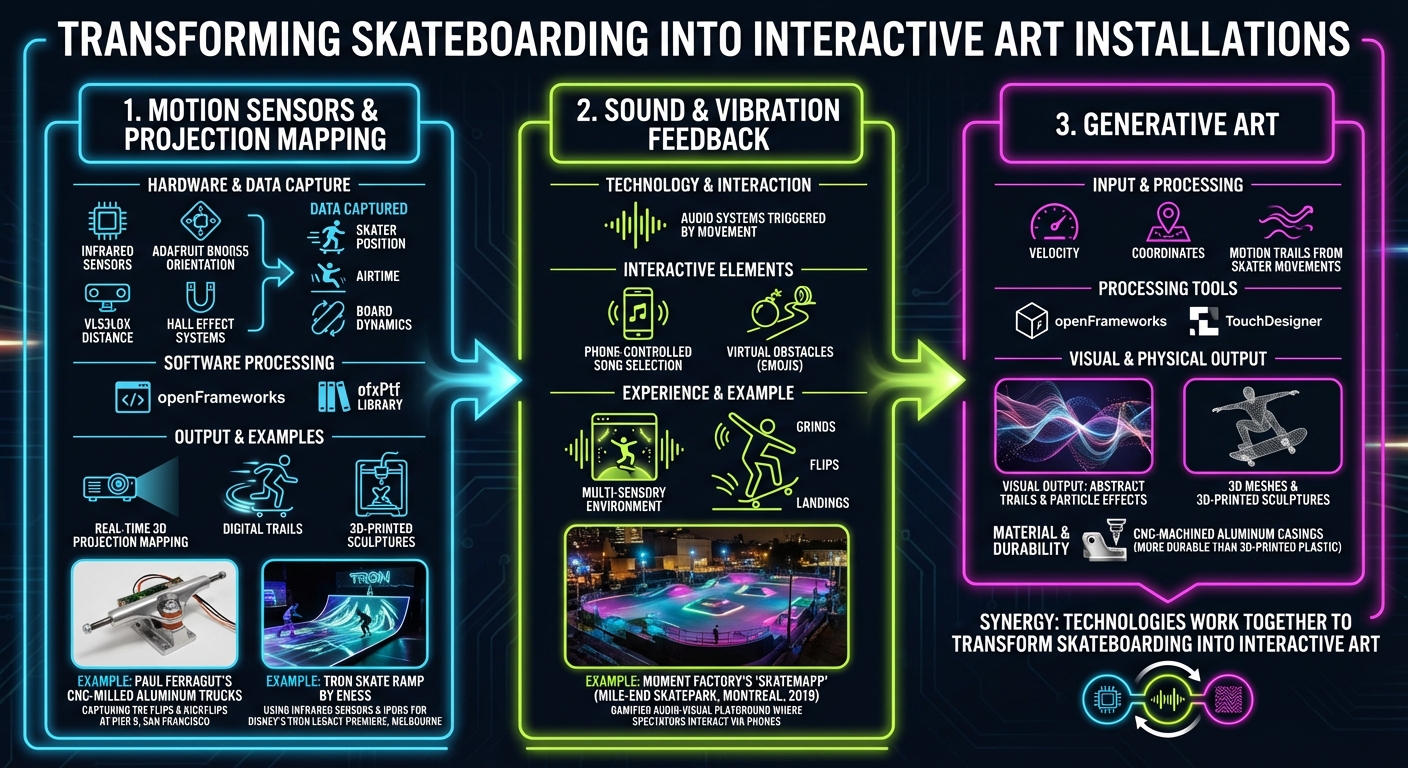
Cutting-edge technology like advanced sensors, real-time projection, audio triggers, and generative algorithms are transforming skateboarding into a dynamic art form, blending physical performance with interactive visuals and sound.
Motion Sensors and Projection Mapping
Artists use infrared sensors and position-tracking hardware to precisely monitor a skater's movements, including their location and airtime. This data is fed into specialized software that turns skate ramps into responsive canvases, where visuals continuously adapt to every trick and motion.
A striking example of this was the "TRON SKATE RAMP", created by design studio ENESS for Disney's Tron Legacy premiere in Melbourne. By combining infrared sensors and iPods, the ramp captured skaters' positions and airtime, triggering real-time 3D projection mapping and sound. ENESS described their creation as "a seamless canvas of light and sound, directly triggered by the skateboarders' movements".
The technology behind such setups often includes orientation sensors like the Adafruit BNO055, distance sensors such as the VL53L0X, and Hall effect systems to track the board's dynamics. At Pier 9 in San Francisco, Paul Ferragut took this concept further by embedding these sensors into CNC-milled aluminum trucks. Data from tricks like Tre Flips and Kickflips was processed using openFrameworks, producing digital trails and even 3D-printed sculptures.
To enhance the visual experience, audio feedback is often layered in, adding another dimension to these interactive installations.
Sound and Vibration Feedback
Sound systems play a key role in amplifying the sensory impact of skateboarding. For instance, in 2019, creative studio Moment Factory developed "SkateMapp" for the MAPP_MTL projection mapping festival in Montreal. At the Mile-End Skatepark, spectators could interact with the skaters' environment by using their phones to pick songs or send virtual obstacles (like emojis) onto the projected track. This gamified the experience, turning the skatepark into a collaborative audio-visual playground.
By integrating sound systems that react to every grind, flip, or landing, skateparks become immersive spaces where physical performance and digital art collide, creating a multi-sensory experience for both skaters and spectators.
Generative Art Through Skateboarding
Generative art takes motion data from skateboarding and turns it into stunning visual effects. Tools like openFrameworks or TouchDesigner interpret a skater's movements - such as their velocity and coordinates - to produce abstract trails or particle effects. These visuals can be displayed live or exported as 3D meshes to create physical sculptures.
Paul Ferragut has explored this idea extensively, capturing trick data and transforming it into immersive 3D scans. These scans can then be converted into physical sculptures using 3D printing, preserving the unique motion and style of individual skaters. To ensure durability, Ferragut found that CNC-machined aluminum casings worked better than 3D-printed plastic for his custom tracking systems.
Artists can also use open-source tools like the ofxPtf library for openFrameworks to convert motion trails into exportable 3D meshes. This opens up endless possibilities for those looking to experiment with blending technology and creative expression in skateboarding.
Installing Skateboard Art in Public Spaces
Designing for Public Interaction
When artists bring tech-inspired skateboard installations into public areas, they face a tricky task: how do you create something that invites people to participate without compromising your artistic vision? The answer often lies in designing pieces that serve multiple purposes and connect with the local community.
Take Inuit artist Mark Igloliorte’s project, Saputiit - Fish Weir Skating Plaza, for example. Unveiled in September 2022 at Toronto’s Yonge-Dundas Square during Nuit Blanche, this installation turned a space where skateboarding is usually banned into a week-long public plaza. Inspired by traditional Inuit fish weirs, the design guided skaters’ movements while celebrating Indigenous culture. It also included an interactive element: QR codes that activated augmented reality, making Arctic char fish appear to swim around skaters at knee height. By collaborating with groups like Nations Skate Youth and Queer Skate Toronto, Igloliorte’s project showcased how inclusivity can help gain city approval for skateboarding in otherwise restricted areas.
"One of the things that I'm hoping to do with this project is that the city will see the possibilities of having skateboarding be something that's part of the urban experience." - Mark Igloliorte, Artist
The best public installations often feature modular designs, allowing for flexibility and encouraging skaters to interact creatively with the space.
Another key to acceptance is multi-use functionality. When these installations double as seating for pedestrians or play areas for children, they blend more seamlessly into the community. This approach helps shift the perception of skateboarders from being seen as troublemakers to being recognized as contributors to urban life.
Solving Practical Challenges
Of course, creating public skateboard art isn’t just about aesthetics and community engagement - it also involves tackling technical and safety challenges.
Durability is a big hurdle. Public installations face constant wear and tear from skateboards, which can quickly damage standard materials. For example, in February 2024, PlayLab Inc and artist Sterling Ruby built a 12-foot-tall neon yellow skateable pyramid in Downtown Los Angeles for LA Art Week. They used salvaged scaffolding and Skatelite - a tough paper composite designed for skateboarding - that had been repurposed from earlier projects in Paris. As PlayLab co-founder Archie Lee Coates IV explained:
"We reimagined an iconic skate culture form - the hill - as a surreal sculpture".
Safety is another critical factor. Designers must avoid creating flat or parallel surfaces that could cause unexpected falls. Architect and pro skater Alexis Sablone addressed this in the spring of 2023 with her Candy Courts project in Montclair, New Jersey. Working with the nonprofit Skate Essex, she transformed a former tennis court into a space featuring seven permanent metal and concrete sculptures. The project, shaped by local youth advocacy, ensured the structures catered to skaters of all skill levels while prioritizing safety.
Legal and spatial conflicts add another layer of complexity. Many public areas use defensive architecture to deter skateboarding. Artists counter this by showcasing the social benefits of temporary installations, proving that skateboarding can coexist peacefully with other urban activities. Designer Leif Hauge summed it up:
"Designing spaces like this in public areas has reduced conflict and has increased openness to skateboarding".
Finally, accessibility is essential for success. Installations should offer engaging textures and forms that cater to beginners while still challenging advanced skaters. By doing so, these projects remain relevant to the entire skateboarding community, ensuring they continue to evolve and inspire.
Carbonated Thoughts: A Platform for Creativity

Design and Branding Services for Artists
For artists blending tech and creativity, Carbonated Thoughts offers a unique platform to bring ambitious ideas to life. Founded by Sean M. Ryan, this service specializes in helping artists navigate the journey from concept to final creation, particularly in tech-integrated skateboard installations. Whether you're dreaming up an immersive, motion-responsive projection or a site-specific art piece, this platform provides the expertise to make it happen.
The platform’s technical consulting services combine design, development, and business insights to help artists execute their creative visions through innovative technology. From brainstorming sessions to hands-on guidance, the services are tailored to meet the needs of both small-scale projects and large public installations.
Here’s the breakdown of services and pricing:
- Creativity sessions: $30/hour
- Business consulting: $100/hour
- Graphic design: $55/hour (minimum 3 hours)
- Website setup: $100/hour (minimum 3 hours)
This flexible pricing structure ensures that artists, regardless of project size, can access professional support.
Skateboards as Art
Carbonated Thoughts doesn’t stop at consulting - it reimagines skateboards as functional works of art. Each skateboard becomes a personalized canvas, often tied to meaningful causes. For example, the platform commits to planting a tree for every skateboard sold, blending creativity with a strong community focus.
For artists working with data-driven techniques - such as tracking orientation, height, and speed via electronics - these custom skateboards offer a fresh medium to showcase their craft. They bridge the gap between temporary tech-driven installations and everyday functionality. By transforming skateboards into artistic and technological statements, Carbonated Thoughts invites a broader audience to experience the intersection of art, technology, and skateboarding in a tangible way.
Conclusion
Technology is reshaping how skateboard art comes alive in public spaces. What once were static displays have transformed into dynamic, interactive experiences - think projections that respond to movement, data-powered sculptures, and generative art installations where skaters become co-creators. As Eric Cade Schoenborn and Ed Selego aptly said:
"We turned life into an animated GIF and skated it".
This evolution doesn’t just redefine artistic expression; it also reimagines urban spaces. These installations breathe new life into neglected or even unwelcoming environments, turning them into vibrant community hubs. Take Finding a Line, for instance - a perfect example of creative placemaking - or Paul Ferragut’s work, which immortalizes fleeting skate tricks as 3D-printed sculptures.
Beyond aesthetics, technology is making skateboard art more accessible. Interactive elements like augmented reality and photo opportunities invite non-skaters to engage, while digital platforms connect skaters worldwide, fostering a sense of community. The blending of the physical and digital worlds continues to push boundaries, with emerging technologies like blockchain and AI opening up even more possibilities.
With laws in many states requiring that 1% of new construction budgets go toward public art, these tech-driven projects are not only visually captivating but also lay the foundation for more inclusive communities and reimagined urban landscapes.
FAQs
How does technology like motion sensors and projection mapping bring skateboard art to life?
Motion sensors and projection mapping are changing the way we experience skateboarding, turning it into an interactive art form. Using sensors, every movement a skater makes - whether it’s their speed, airtime, or tricks - is captured in real time. This data doesn’t just sit there; it’s used to trigger a symphony of visuals, lights, and sounds that respond instantly to the skater’s actions. Every flip, every grind becomes part of a digital performance.
Projection mapping takes things up a notch by transforming ramps, rails, and skatepark surfaces into dynamic, reactive canvases. Vibrant animations and graphics come alive, syncing perfectly with the skater’s movements. The result? An immersive blend of physical skill and digital artistry that captivates both skaters and onlookers alike. Tricks aren’t just tricks anymore - they’re moments of sensory magic.
Platforms like Carbonated Thoughts celebrate this thrilling mix of skateboarding and creativity. By showcasing skateboards and art that push the envelope, they bring together riders, artists, and the larger skateboarding community in a truly unique way.
What challenges do artists face when creating interactive skateboard art installations?
Designing interactive skateboard art installations comes with its fair share of challenges. One of the biggest is figuring out how to incorporate technology - like LEDs, motion sensors, or projection mapping - into skateboards in a way that can handle heavy use, unpredictable weather, and strict safety requirements. To complicate things further, many artists aim to use reclaimed materials, which adds layers of difficulty when it comes to sourcing and construction.
Another hurdle is finding a public space for the installation. This often means navigating through permit processes, collaborating with property owners, and tailoring designs to fit into existing areas, such as skate parks. Then there’s the ever-present issue of funding. Many artists rely on grants, sponsorships, or even selling merchandise to cover the costs of bringing their ideas to life. Successfully balancing creative vision with these technical, logistical, and financial challenges is what ultimately makes these installations possible.
How is technology transforming skateboarding into interactive art?
Technology is reshaping skateboarding by turning every movement into a canvas for digital art. Imagine this: motion-responsive systems track a skater’s tricks and instantly project dazzling visuals onto nearby surfaces, blending light and motion in real time. Some setups even go a step further, embedding sensors in skateboard trucks to collect data. This data can be transformed into 3D models, digital animations, or even physical sculptures, pushing the boundaries of creativity.
This mix of skate culture and tech is unlocking exciting opportunities for both skaters and artists. Platforms like Carbonated Thoughts are central to this evolution, offering skateboards, apparel, and creative services that empower artists to bring their tech-driven visions to life and share them with broader audiences.