

5 Eco-Friendly Packaging Ideas for Skate Brands
Skate brands can cut costs and reduce waste by switching to eco-friendly packaging. Common materials like plastic shrink wrap and foam inserts harm the planet, but alternatives exist that are recyclable, biodegradable, and lightweight. Plus, consumers are willing to pay more for sustainable options - 57% say they'll spend 10% extra for greener packaging. Here are five practical ideas skate brands can use today:
- Recycled Cardboard Boxes: Durable and recyclable, these boxes save 20–30% compared to virgin materials. Perfect for shipping skateboards and hardware.
- Twine-Wrapped Boards with Cardboard Inserts: Combines biodegradable twine with lightweight recycled inserts, reducing material waste and shipping costs.
- Agricultural Waste-Based Cartons: Made from crop byproducts like wheat straw, these cartons are compostable and offer strong protection for fragile items.
- Card-Based Packaging for Accessories: Ideal for apparel and small items, these packages use recycled paperboard to cut emissions and landfill waste.
- Reinforced Post-Consumer Recycled Cartons: Heavy-duty and cost-effective, these cartons are best for shipping trucks and complete setups.
Quick Tip: Optimize box dimensions to lower shipping fees and ensure durability during transit. Eco-friendly packaging not only aligns with skate culture values but also builds trust with environmentally conscious customers while saving money in the long run.
How to make low cost skateboard shipping boxes at home
sbb-itb-e116ef9
1. Recycled Cardboard Boxes with Custom Branding
Recycled cardboard boxes give skate brands an effective way to cut costs while reducing their environmental impact. Made from 50% to 100% recycled fiber, these boxes are versatile for brands of all sizes. Smaller companies, in particular, can take advantage of digital printing, which allows for minimum orders as low as 500 units.
Material Source
Recycled paperboard helps minimize landfill waste and reduces carbon emissions by up to 25% compared to using virgin fiber. It also supports a circular economy since it can be recycled repeatedly. Modern Coated Recycled Board (CRB) offers impressive durability, with edge-crush test scores of 32–44 lbs/in². This strength nearly rivals virgin materials, making it a reliable choice for shipping complete skateboards or heavy skate hardware.
Cost Savings Potential
Switching to recycled cardboard can save brands 20–30% compared to virgin Solid Bleached Sulfate (SBS) board. Custom-sized cartons further reduce costs by minimizing the need for void fill and lowering shipping expenses. For moderate order volumes, recycled corrugated boxes are priced between $0.34 and $0.68 per unit, while custom FSC-certified kraft cartons range from $0.48 to $0.95 per unit. These savings, combined with the recyclability of cardboard, make it a practical and eco-conscious packaging solution.
Recyclability
Cardboard is fully recyclable and biodegradable, keeping it out of landfills and oceans. Using soy-based inks on recycled boxes can cut volatile organic compounds (VOCs) by 30%, while FSC Recycled certification ensures the fiber used comes from verified sources. With 73% of shoppers preferring brands that use recyclable packaging, this choice not only supports sustainability but also strengthens customer loyalty. Its adaptability to various shipping needs makes recycled cardboard a smart option for skate brands.
Skate Brand Suitability
Recycled cardboard is tough enough to handle the shipping demands of skate products. For items like complete skateboards or heavier hardware, double- or triple-wall recycled corrugate provides the necessary stacking strength. High-speed inkjet printing adds a layer of customization, enabling brands to create unique graphics for special-edition releases without generating excess waste.
"Recycled paperboard has crossed the line from 'nice idea' to 'non-negotiable.' It cuts costs, shrinks carbon footprints, and delights a consumer base that now checks recycling logos before checking out."
- Christal Wong, BrillPack
2. Twine-Wrapped Boards with Recycled Cardboard Inserts
Twine-wrapped boards take the practicality of recycled cardboard a step further, combining eco-friendly materials with a natural, polished look. This packaging method uses biodegradable twine to secure the board, while recycled cardboard inserts provide lightweight support. By replacing foam blocks or plastic cradles, this approach reduces material waste and shipping costs.
Material Source
Recycled cardboard inserts are made with 50% to 100% post-consumer or post-industrial fiber, helping to divert waste from landfills and support a circular economy. For skateboards, materials like E-flute corrugated or 1.5 mm microflute grades ensure durability while keeping the package lightweight. Additionally, producing recycled board uses about 50% less energy than manufacturing virgin board. Custom die-cut designs ensure the inserts fit the board snugly, eliminating the need for extra filler.
Cost Savings Potential
Recycled kraft inserts are cost-effective, priced at approximately $0.11–$0.18 per unit for moderate quantities. Opting for Coated Recycled Board (CRB) instead of virgin Solid Bleached Sulfate (SBS) can lead to savings of 10–30%. For skate brands, these savings are compounded by lower freight costs due to the lighter weight of the inserts, making this option both economical and environmentally conscious.
Recyclability
Both the twine and recycled cardboard inserts are fully recyclable through standard paper recycling streams, making disposal easy for retailers and customers alike. Using kraft paper tape instead of plastic tape further simplifies recycling, creating a mono-material package. This aligns with Amazon's Climate Pledge, which requires vendors to adopt 100% recyclable materials by 2025.
Skate Brand Suitability
Twine-wrapped packaging offers the durability needed for skate products while reinforcing an eco-conscious brand image. However, it’s essential to test the insert within the final shipping box to ensure the board remains stable during transit. For heavier boards, multi-layered inserts or friction-fit walls can provide extra compression and prevent movement, ensuring secure delivery.
"A well-designed recycled insert would have protected the item just as well, cost less to ship, and looked far better on the unboxing table."
- Custom Logo Things
3. Agricultural Waste-Based Flat Shipping Cartons
Agricultural waste-based cartons offer a fresh take on sustainable packaging. By turning harvest leftovers - like corn stalks, wheat straw, and crop stems - into sturdy shipping boxes, these cartons provide a lightweight yet durable option for shipping. This solution has gained attention, especially among skate brands, as traditional cardboard prices have surged by 60–70% since 2021.
Material Source
These cartons are crafted from agricultural byproducts, such as stems and leaves left after crops are harvested. The waste is processed into paperboard that functions much like wood-pulp cardboard but with a smaller environmental impact. Some manufacturers are even blending agricultural waste with mushroom mycelium to create custom-shaped inserts that naturally degrade within 30–90 days. This blend of practicality and eco-consciousness makes these materials stand out.
Cost Savings Potential
Although these cartons cost 20–40% more than standard recycled corrugated boxes (typically priced between $0.34 and $0.68 per unit), brands can offset the higher price through reduced damage rates and lighter shipping weights. Even small adjustments, like reducing the depth of cartons by 1 inch, can lower dimensional weight charges significantly. Emerging skate brands can also save on costs by starting with neutrally branded agricultural waste cartons and customizing them with stickers, avoiding the steep minimum order requirements for custom printing.
Recyclability
These cartons are fully recyclable through standard paper recycling processes and maintain standard ECT ratings. Before placing large orders, it’s wise to test for humidity sensitivity and seam durability to ensure the cartons meet your needs.
Skate Brand Suitability
Agricultural waste-based cartons strike a balance between strength and environmental responsibility. They are a great fit for shipping skate decks, as they can be designed for high durability while using less material than traditional boxes. Their compact design reduces the need for extra void fill and makes pallet stacking more efficient. Plus, with 78% of consumers willing to pay more for eco-friendly packaging, these cartons can highlight your brand’s dedication to sustainability and quality.
"Mushroom packaging is cost-effective since it utilizes a less-demanded part of mushrooms... businesses don't have to sacrifice quality to be environmentally responsible."
- Stephen Fowler, Writer, Ibex Packaging
4. Card-Based Packaging for Apparel and Accessories
Card-based packaging offers a practical and eco-conscious way for skate brands to ship apparel and accessories. By moving away from plastic foam and bulky fillers, brands can embrace recycled paperboard, which not only reduces landfill waste but also lowers carbon emissions by up to 25% compared to virgin fiber production. It's worth noting that 73% of consumers now prefer brands that use recyclable packaging.
Material Source
Recycled paperboard is a standout material, typically containing 50% to 100% post-consumer or post-industrial fiber. Different types cater to various needs:
- Coated Recycled Board (CRB): Features a white clay-coated surface for vibrant printing, making it ideal for apparel boxes and subscription kits.
- Uncoated Recycled Board (URB): Offers a natural, kraft-style finish, perfect for minimalist skate branding or industrial-style sleeves.
- Microflute or E-flute Corrugated Structures: Lightweight yet sturdy, these are great for stabilizing accessories like skate tools, bearings, or hardware without relying on plastic foam.
- 350gsm C1S Artboard: A strong choice for presentation inserts or backing cards for smaller accessories.
Cost Savings Potential
This packaging solution balances aesthetics with affordability. For instance, recycled kraft inserts for small accessory boxes typically cost between $0.11 and $0.18 per unit at moderate volumes. Custom runs as small as 500 units are possible with high-speed inkjet printing, making it easier to test limited-edition designs without steep upfront costs. Plus, using soy-based inks not only ensures vibrant colors but also cuts volatile organic compounds (VOCs) by 30%, maintaining the material's recyclability.
Recyclability
Recycled paperboard is fully recyclable through standard curbside programs and can be recycled multiple times. Its production also uses 50% less energy and generates 23 times fewer greenhouse gases compared to virgin board production. To ensure recyclability, brands should avoid glossy PVC laminations and instead opt for matte, uncoated finishes or water-based varnishes. Modern recycled boards can even achieve edge-crush test scores of 32–44 lbs/in², rivaling the strength of virgin materials.
Skate Brand Suitability
This type of packaging is a natural fit for skate brands focused on sustainability. Recycled inserts snugly hold apparel and accessories in place, reducing the risk of scuffing or label damage during transit. For heavier items like skate tools or hardware, multi-ply construction or E-flute structures provide added durability.
Additionally, variable-data printing allows brands to personalize packaging with unique QR codes or customer names, which has been shown to increase repeat orders by 35%. Adding functional elements, like a collector's checklist or care instructions on the back of the packaging, can enhance its value without requiring more materials. This thoughtful approach aligns perfectly with skate culture's focus on simplicity and environmental responsibility.
5. Reinforced Cartons from Post-Consumer Recycled Materials
Reinforced cartons made from post-consumer recycled materials provide the strength needed for skate hardware like decks, trucks, and complete setups while keeping environmental impact in check. These materials are sourced from curbside recycling programs, damaged cardboard diverted from waste streams, and post-industrial fiber.
Material Source
The foundation of these cartons is recycled paperboard, containing at least 50% post-consumer or post-industrial fiber, with some reaching 100%. A standout option is tan bending chip, an unbleached material with up to 90% post-consumer waste content. For brands requiring extra toughness, triple-wall recycled corrugate offers heavy-duty protection, capable of handling weights of 60 lbs or more. Thanks to modern multi-ply construction, these materials deliver structural stiffness comparable to virgin fiber alternatives.
Cost Savings Potential
Beyond their quality, these cartons also offer cost advantages. Recycled board is 10% to 30% cheaper than virgin fiber options like Solid Bleached Sulfate. One brand, for example, cut its annual packaging costs by 12% by switching to 60% post-consumer board. Standard recycled corrugated cartons are priced between $0.34 and $0.68 per unit, while custom FSC-certified kraft cartons range from $0.48 to $0.95. Adjusting carton dimensions, such as reducing depth by even an inch, can lower dimensional weight charges and eliminate the need for plastic void fill. Bulk orders of 15 or more units can lead to savings of up to 15%.
Recyclability
These cartons are not only functional but also environmentally friendly. They are 100% curbside recyclable and biodegradable. Life-cycle analyses reveal a 15% to 25% lower carbon footprint compared to virgin materials. They can be recycled multiple times through standard paper recycling programs, contributing to the circular economy. For instance, HP uses triple-wall recycled corrugate rated for 60 lbs to ship desktop printers globally, eliminating Styrofoam and complying with EU packaging standards.
Skate Brand Suitability
This packaging solution is a natural fit for skate brands, combining durability with a minimalist aesthetic that resonates with skate culture. For heavier gear like trucks or hardware, specifying 44 ECT or double-wall construction ensures protection during shipping. High-speed digital printing allows for small production runs of 500–1,000 units, making it easy to test limited-edition designs or seasonal releases without high setup costs. Pairing these cartons with soy-based inks creates a fully recyclable package.
Comparison Table
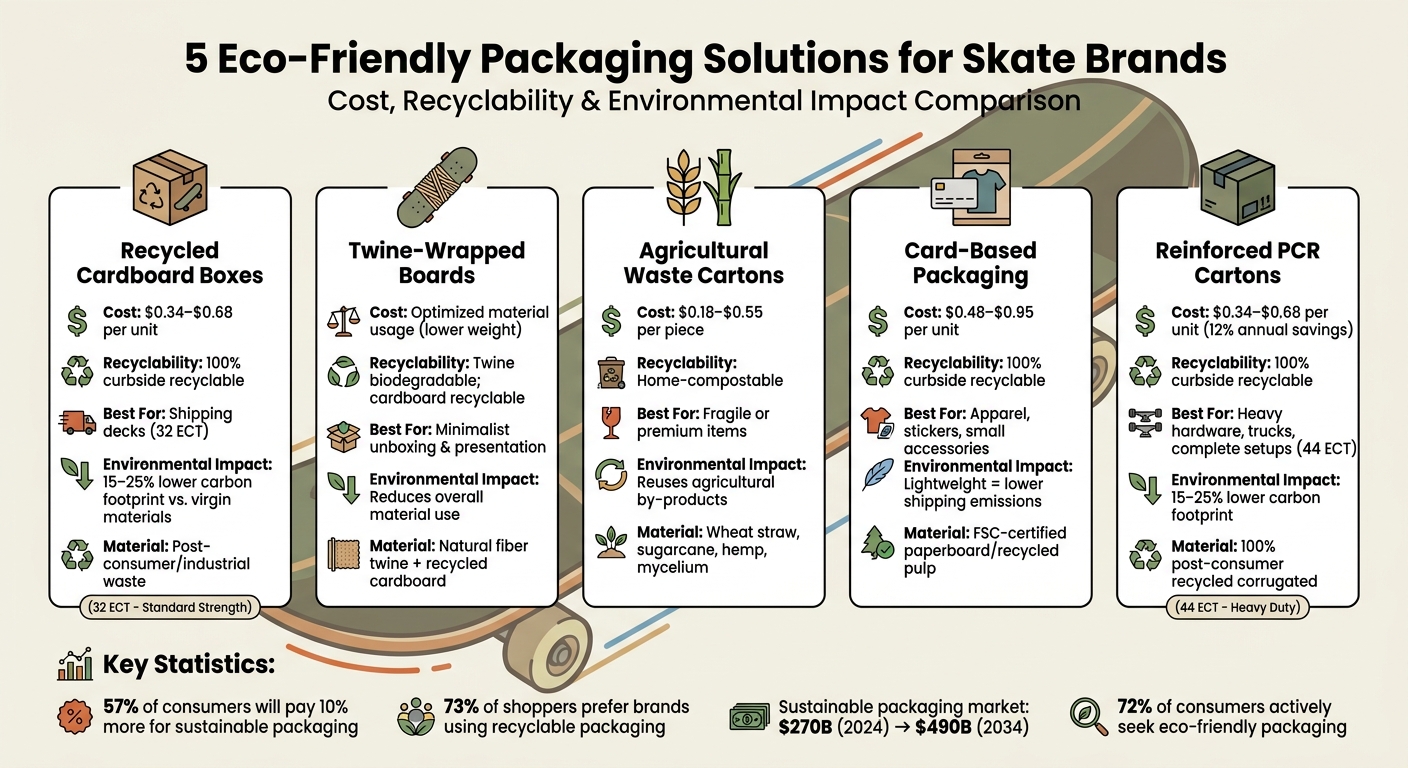
Eco-Friendly Packaging Options for Skate Brands: Cost and Environmental Comparison
The table below pulls together the essential details from the packaging options discussed earlier.
| Packaging Option | Material Source | Cost Savings Potential | Recyclability | Best Use for Skate Brands | Environmental Impact Reduction |
|---|---|---|---|---|---|
| Recycled Cardboard Boxes | Post-consumer/industrial waste | $0.34–$0.68 per unit | 100% curbside recyclable | Great for shipping decks (32 ECT) | 15–25% lower carbon footprint compared to virgin materials |
| Twine-Wrapped Boards | Natural fiber twine + recycled cardboard inserts | Optimized material usage lowers weight and cost | Twine is biodegradable; cardboard is recyclable | Perfect for minimalist unboxing and stylish presentation | Reduces overall material use |
| Agricultural Waste Cartons | Wheat straw, sugarcane bagasse, hemp hurd, or mycelium | Around $0.18–$0.55 per piece | Home-compostable | Best for fragile or premium items needing cushioning | Reuses agricultural by-products, cutting reliance on virgin materials |
| Card-Based Packaging | FSC-certified paperboard or recycled pulp | $0.48–$0.95 per unit; reduces dimensional weight charges | 100% curbside recyclable | Ideal for apparel, stickers, and small accessories | Lightweight design helps cut shipping emissions |
| Reinforced PCR Cartons | 100% post-consumer recycled corrugated | 12% annual cost savings; $0.34–$0.68 per unit | 100% curbside recyclable | Best for heavy hardware, trucks, and complete setups (44 ECT) | Keeps waste out of landfills; 15–25% lower carbon footprint |
These packaging options cater to different brand needs while promoting eco-conscious practices.
For most skate brands, recycled corrugated cartons strike the best balance - they're affordable, durable, and fully recyclable, making them a solid choice for shipping decks and hardware. Packaging expert CustomLogoThing emphasizes:
"The greenest carton on the spec sheet is not always the greenest carton in real life. If it crushes, tears, or features 40% empty space, you've already lost the argument."
For lighter items like apparel and accessories, card-based packaging helps minimize shipping costs by reducing dimensional weight. On the other hand, agricultural waste cartons shine when shipping fragile or premium products, offering excellent cushioning while staying compostable.
Ultimately, these solutions not only meet shipping needs but also reflect the eco-friendly ethos of modern skate culture. Plus, sustainable packaging often proves more affordable in the long run, thanks to lower shipping surcharges and fewer returns due to damaged products.
Conclusion
The sustainable packaging market is expected to grow from $270 billion in 2024 to $490 billion by 2034, with 72% of consumers actively seeking out brands that prioritize eco-friendly packaging. For skate brands built on authenticity and counterculture, sustainable packaging isn’t just a choice - it’s a natural extension of their core values.
This commitment to the environment can also lead to long-term savings and increased customer loyalty. While eco-friendly materials might cost 10–30% more upfront, these costs are typically recouped within 12–18 months thanks to lighter packages, reduced shipping fees, and better use of warehouse space. Plus, 57% of consumers are willing to pay 10% more for packaging that’s environmentally responsible, proving that sustainability doesn’t have to come at the expense of profitability.
The stakes couldn’t be higher. By 2050, it’s estimated that oceans may contain more plastic than fish. Every recycled deck carton or FSC-certified tee package plays a part in reversing this grim outlook. Even small changes can make a big difference - ASOS, for instance, reduced its annual plastic use by 583 tons simply by making its mailer bags thinner.
To make the most of sustainable packaging, focus on optimizing box dimensions and rigorously testing for durability. Use your packaging as an opportunity to educate customers by including clear recycling instructions or QR codes that explain how to dispose of materials properly. As Erika Geraerts, founder of Fluff, wisely points out:
"Try and make those better decisions from the start because it's so much easier than having to undo or replace packaging or formulation or componentry down the road".
Packaging is often the first physical interaction customers have with your brand. Choose materials that not only reflect the eco-conscious spirit of skate culture but also leave a lasting impression. By embracing eco-friendly packaging, your brand can help shape a more sustainable future for skate culture and beyond.
FAQs
Which packaging option is best for decks vs. apparel vs. hardware?
When shipping skateboard decks, go for eco-friendly and durable packaging like recycled cardboard tubes or sturdy boxes. These options not only protect the decks during transit but also align with environmentally conscious practices.
For apparel, consider lightweight and recyclable materials such as biodegradable bags or paper-based mailers. These reduce both shipping weight and costs while being easier on the planet.
As for hardware, compact and sturdy packaging is key. Molded pulp or recycled cardboard boxes work well to safeguard items from damage during handling and shipping.
How do I choose the right box strength (ECT) for my products?
To figure out the right box strength (ECT) for your needs, think about a few key factors: the weight and fragility of your items, how they'll be stacked, and the shipping conditions they'll face. The ECT rating tells you how much compression a box can handle when stacked. For most products, a 32 ECT box does the job. But if you're dealing with heavier items, you might need something stronger, like 44-48 ECT. The goal is to find a balance - strong enough to protect your products but not so overbuilt that you're spending more than necessary.
What changes make packaging easier to recycle for customers?
To create packaging that’s easier to recycle, focus on using recyclable materials, cutting out any unnecessary parts, and designing lightweight packaging that can be efficiently handled by recycling facilities. These efforts not only make the packaging more environmentally friendly but also make it simpler for customers to recycle.