

CarbonNeutral Protocol Documentation Guide
The CarbonNeutral Protocol is a framework that helps businesses measure, reduce, and offset their greenhouse gas (GHG) emissions to achieve carbon neutrality. The 2025 edition introduces stricter guidelines, requiring measurement of all 15 Scope 3 categories and independent review of reduction targets. Proper documentation is essential to verify compliance and ensure credibility. Key documents include:
- GHG Assessment Report: Details emissions calculations.
- Carbon Management Plan: Outlines reduction strategies and timelines.
- Proof of Carbon Offset Retirement: Confirms use of approved carbon credits.
- Scope 3 Inventory: Covers all indirect emissions sources.
- Energy Attribute Certificates (EACs): Validates renewable energy use.
Certification involves defining your scope, collecting and verifying emissions data, and planning reductions. The process ensures alignment with international standards like the Paris Agreement. Once certified, organizations can use the CarbonNeutral® label to communicate their efforts transparently.
Documentation Requirements Explained
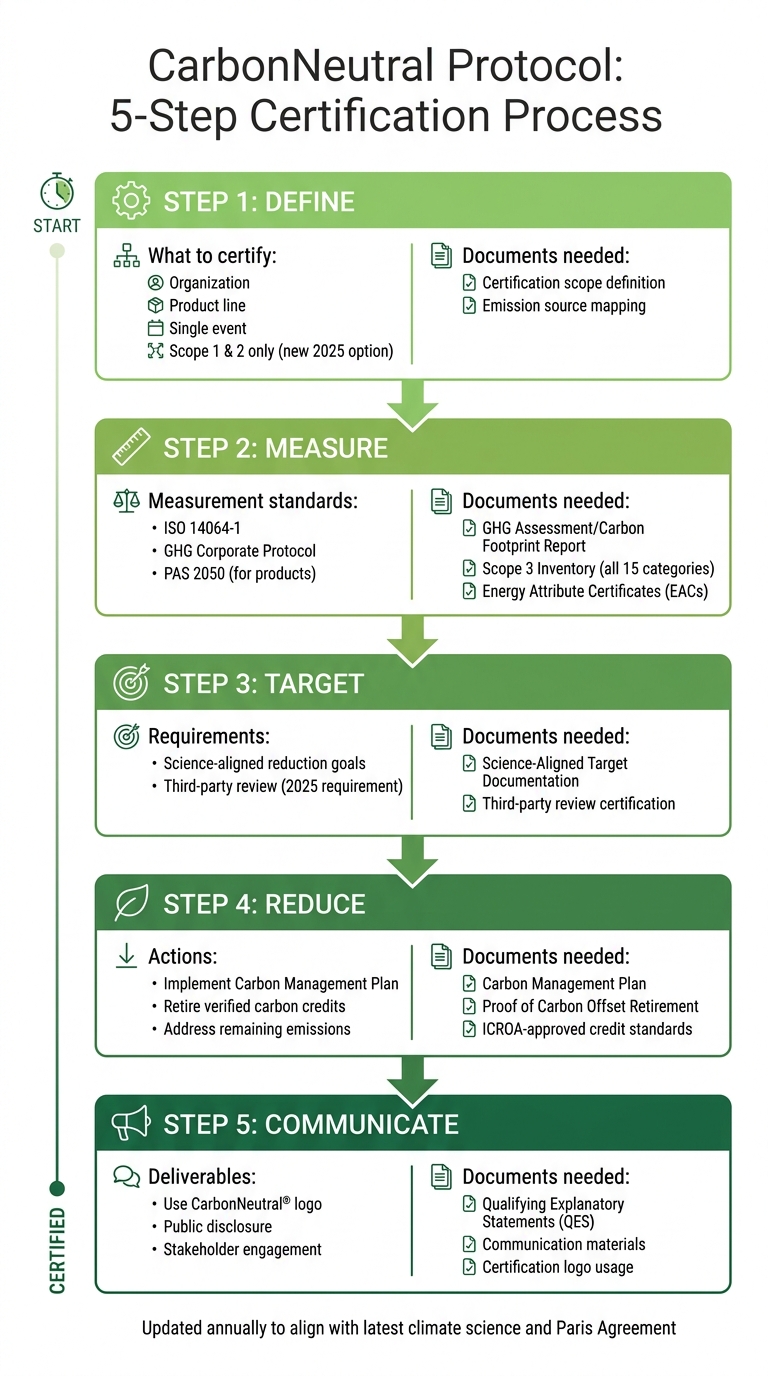
CarbonNeutral Protocol 5-Step Certification Process and Required Documents
The CarbonNeutral Protocol involves five key steps, each requiring specific documentation to confirm compliance. These steps include defining what you’re certifying, measuring your greenhouse gas emissions, setting reduction goals, reducing and offsetting emissions, and sharing your results.
Core Protocol Components
The framework of the Protocol follows a logical sequence. First, you define the subject of your certification - this could be your entire organization, a particular product line, or even a single event. Next, you measure emissions using approved methodologies, such as ISO 14064-1 or the GHG Corporate Protocol. For products and services, PAS 2050 life-cycle assessments are often applied. During the target phase, you establish reduction goals aligned with scientific standards. The reduce phase involves implementing your Carbon Management Plan and retiring verified credits to address any remaining emissions. Finally, you communicate your results, using approved channels and the CarbonNeutral® certification logo. The documents required to support each of these steps are outlined in the next section.
Required Documents
The certification process relies heavily on documentation to connect emissions measurement with verified climate actions. Here’s what you’ll need:
- GHG Assessment or Carbon Footprint Report: This includes detailed calculations based on established methodologies.
- Carbon Management Plan: Outlines reduction targets, timelines, and methods, including the purchase of offset credits.
- Qualifying Explanatory Statements (QES): A public declaration explaining how you’ve offset any remaining emissions.
- Proof of Carbon Offset Retirement: Confirms that carbon credits from approved standards have been retired within a recognized registry within one year of your claim.
- Science-Aligned Target Documentation: Required under the 2025 Protocol, this shows that a qualified third party has reviewed your reduction targets.
- Energy Attribute Certificates (EACs): Necessary if you’re using renewable energy, these must align with the location of your electricity transmission and distribution losses.
- Scope 3 Inventory: A complete inventory covering all 15 categories is mandatory for full organizational certification.
"TitanZero™ candle wax blend was the first Carbon Neutral product we have had certified at Calumet. SCS took great care to explain how we could best capture the value from the certification and how to clearly identify the allowable claims." - Lindsey LaBerge, Director of Corporate Marketing, Calumet Specialty Products Partners
Documentation Challenges and Solutions
For many businesses, measuring all 15 Scope 3 categories - which range from employee commuting to the disposal of sold products - can be a major challenge. Another difficulty lies in setting science-aligned targets, which now require review by qualified third parties with documented expertise. Large organizations may also struggle with determining whether subsidiaries should set their own targets or follow the parent company’s framework. Under the 2025 Protocol, subsidiaries can now establish independent science-aligned targets if they operate autonomously.
To navigate these hurdles, consult Tables 4, 5, and 6 in the Protocol’s Technical Specification, which clarify the distinctions between measurement and compensation sources. When addressing transmission and distribution losses, ensure your EAC location matches your electricity loss location and disclose your calculation methods. For organizations working across borders, Guidance 4.8 provides detailed instructions on managing corresponding adjustments under Article 6 of the Paris Agreement.
With these documentation requirements in mind, the next step is to define your certification scope and verify your data to move forward in the process.
sbb-itb-e116ef9
Preparing for Certification
Getting ready for certification involves three essential steps. Start by clearly identifying your certification scope, as this lays the groundwork for collecting data and planning emissions reductions.
Step 1: Define Your Certification Scope
Your first task is to decide on the certification type that fits your needs. The 2025 Protocol now offers a "CarbonNeutral® Scope 1 and 2" certification in addition to full organizational and product certifications. This gives you some flexibility if you're not prepared to tackle all 15 Scope 3 categories. For those in larger organizations, you can set independent science-aligned targets and certification scopes for subsidiaries, thanks to updates in the Protocol. After that, map out all relevant emission sources across Scope 1, Scope 2, and applicable Scope 3 categories. The Protocol's Technical Specifications can help you classify these emission sources. Be sure to match T&D losses with the appropriate Energy Attribute Certificates and disclose the methods used for your calculations.
Step 2: Collect and Verify Emissions Data
Accurate data collection is critical and aligns with the Protocol's technical requirements. For full organizational certification, you’ll need to account for emissions across all 15 Scope 3 categories, which cover a variety of indirect sources. The Protocol uses established independent standards to guide greenhouse gas accounting. When calculating specific emissions, like T&D losses, it’s important to disclose the methods you used. Once your emissions data is verified, you can turn your attention to crafting a reduction strategy.
Step 3: Plan for Emissions Reductions
Your reduction plan should align with the Protocol's 12 key initiatives. Set internal targets based on the latest technical specifications and mid-year updates. This plan can be tailored to fit your business model. For instance, some companies focus on certifying individual consumer products, while others prioritize managed services or their entire operations. Stay updated with mid-year changes to ensure your strategies remain compliant. If your business is heavily service-oriented, explore the specialized frameworks provided in the Protocol to guide your reduction efforts. This plan will work alongside your documentation, helping you move toward certification.
Once your scope is defined, data is collected, and your reduction plan is in place, you’ll be ready to submit your documentation for certification.
Submitting Your Documentation
After completing your data collection and reduction planning, it's time to submit your documentation as outlined below.
Formatting and Organizing Documents
The Protocol relies on standardized table formats to present measurement and compensation data clearly. Refer to Tables 4, 5, and 6 in the Technical Specification to differentiate between emissions sources that are measurement-required, compensation-required, and compensation-recommended. When addressing Energy Attribute Certificates (EACs) related to transmission and distribution losses, include your calculation method and confirm that the EAC location aligns with the electricity losses being reported. If a subsidiary is being certified independently from its parent organization, you can document science-aligned targets specifically for the subsidiary, following the guidance in Technical Specification 3.2.
To ensure accuracy and credibility, validation by a qualified third party is essential. The CarbonNeutral Protocol emphasizes:
"An organization's near-term target must have been set and/or reviewed by a qualified third party which has appropriate experience in setting or evaluating the integrity of science aligned targets."
Before submission, confirm that the evaluator meets the qualifications for third-party review. Once your documentation is properly formatted, you can move forward with certification body engagement.
Working with Certification Bodies
Climate Impact Partners is responsible for awarding CarbonNeutral certifications to organizations that meet the necessary technical standards. Certification bodies will verify that your carbon credits adhere to approved standards (outlined in Table 10) and that your documentation aligns with the updated measurement order. Since the Protocol undergoes annual revisions to reflect the latest developments in climate science and international policies, always use the most current templates - currently, the 2025 edition - for your submission.
Communicating Your Certification
Once your certification is in hand, the next step is all about sharing your achievement effectively. The goal here is to communicate your climate action journey - covering everything from measurement to reduction and compensation - using the tools and logo provided. This shift from simply documenting your efforts to actively communicating them helps build trust with stakeholders who value transparency in sustainability efforts.
Using the CarbonNeutral Label
The CarbonNeutral® label is more than just a symbol; it’s a way to reinforce the credibility of your certification. To ensure consistency and compliance, the logo comes with clear usage guidelines. You can use the label on everything from product packaging and marketing materials to corporate websites and internal communications, provided you follow the specifications.
When displaying the label, it’s crucial to specify what’s certified. Is it a product? A service? Or your entire organization under the "CarbonNeutral® Scope 1 and 2" certification? This clarity avoids misunderstandings and strengthens your credibility, especially with audiences who are increasingly vigilant about environmental claims.
"We support you to deliver a clear and credible message about each stage of your climate action to your stakeholders, providing tips, tools, copy, images, a certification logo and case studies of best practice communications." – CarbonNeutral.com
Transparency is key. Always disclose the carbon credit standards you’ve used, referencing the ICROA-approved list (Table 10). This level of openness is essential, especially as research indicates a 50% rise in Fortune Global 500 companies that have either achieved or committed to carbon neutrality.
Telling Your Sustainability Story
To make your certification resonate, use a variety of communication channels to share your sustainability journey. Case studies, digital content, and stakeholder presentations are excellent ways to explain the rigorous steps behind your certification. Highlight the thorough measurement, third-party verification, and science-based targets that set your efforts apart from superficial claims of sustainability.
Additionally, emphasize that your certification protocol is updated annually, reflecting the latest climate science and international policies like Article 6 of the Paris Agreement. This demonstrates that your commitment evolves with current standards rather than relying on outdated practices.
Engage both internal and external audiences - whether it’s your employees, customers, investors, or partners. By creating a narrative that’s authentic and backed by solid actions, you can foster broad support for your initiatives and build trust across all stakeholder groups.
Conclusion
The CarbonNeutral Protocol's documentation process, while detailed, ensures that climate actions are both reliable and measurable. Since its inception in 2002, the Protocol has been updated annually to stay aligned with the latest climate science and policies.
This process involves verifying emissions across all 15 Scope 3 categories, setting short-term science-based targets that are reviewed by qualified third parties, and offsetting unavoidable emissions using ICROA-approved credits. As noted: "It underpins CarbonNeutral® certifications awarded by Climate Impact Partners to organizations that achieve the technical requirements within." This level of rigor helps separate authentic climate initiatives from surface-level claims.
FAQs
What changes in the 2025 CarbonNeutral Protocol affect documentation?
The 2025 CarbonNeutral Protocol brought several updates to its certification framework. One notable change is the introduction of an extended grace period for certification, giving organizations more flexibility in meeting requirements. Additionally, it now includes the CarbonNeutral® Scope 1 and 2 entity certification, which focuses on direct emissions and purchased energy.
Another key update involves revised guidelines for measuring and compensating emissions sources. These adjustments are designed to simplify the compliance process while ensuring that critical emission categories are effectively addressed.
How can I complete all 15 Scope 3 categories without missing data?
To address all 15 Scope 3 categories, refer to the CarbonNeutral Protocol for detailed guidance. Begin by familiarizing yourself with the categories, such as purchased goods and services and use of sold products.
Gather data in an organized manner from suppliers, business partners, and customers. Leverage the protocol's tools to ensure consistency and accuracy. Be sure to document your data sources and collection methods thoroughly, and make it a point to review and refine your process on a regular basis.
For small and medium-sized enterprises (SMEs), there may be allowances or grace periods available to help manage gaps in data collection.
What proof do I need to show offsets were properly retired on time?
To prove compliance, you’ll need to present official retirement certificates or records from recognized standards or registries. These documents must clearly show that emission allowances or credits were permanently removed and confirm that the offsets were retired within the required timeframe.