

How Carbon-Neutral Standards Impact Streetwear
Streetwear brands are under pressure to meet carbon-neutral standards as climate regulations tighten and consumer demands shift. Most emissions (95%-98%) come from supply chains, making material and production choices critical. Key frameworks like the Science Based Targets initiative (SBTi) and ISO 14068-1:2023 guide brands in reducing emissions, focusing on Scope 3 activities like fabric production, dyeing, and shipping.
Key Takeaways:
- Scope 3 emissions dominate (over 80%), covering supply chain activities like material sourcing, manufacturing, and logistics.
- Carbon-neutral certifications require tracking emissions, reducing them, and limiting reliance on offsets.
- Materials matter: Switching to recycled polyester, organic cotton, or regenerative wool can cut emissions significantly.
- Regulations are tightening: California's SB 253 and the EU's CSRD mandate emissions disclosures, while the EU's 2026 ban on product-level "carbon neutral" claims based on offsets adds urgency.
- Practical steps for brands: Focus on emission hotspots, adopt cleaner energy sources, and optimize logistics (e.g., pre-order drops to avoid overproduction).
The stakes are high: brands ignoring these changes risk profit losses of up to 34% by 2030. This guide outlines actionable strategies to align streetwear production with carbon-neutral goals while staying competitive.
Carbon Neutral Standards in Streetwear: The Basics
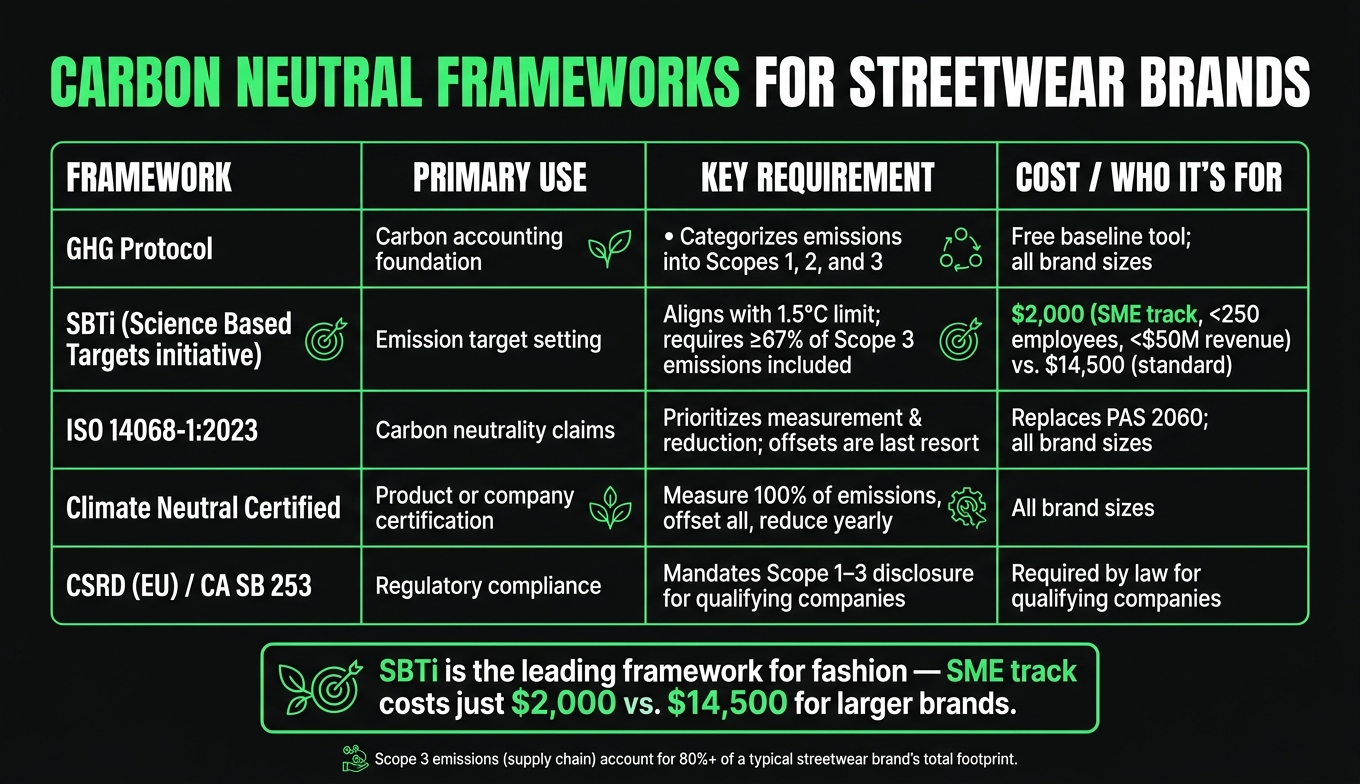
Carbon Neutral Frameworks for Streetwear Brands: Side-by-Side Comparison
Key Terms to Know
Before diving into certifications, it's important to understand some foundational terms.
A carbon footprint refers to all greenhouse gas (GHG) emissions tied to a product or company. This includes everything from raw material extraction to final delivery. These emissions are divided into three Scopes, as defined by the GHG Protocol:
- Scope 1: Direct emissions from sources your brand directly controls.
- Scope 2: Indirect emissions from purchased energy.
- Scope 3: All other indirect emissions across your value chain, such as fabric production, manufacturing, and shipping.
For streetwear brands, Scope 3 emissions dominate the total footprint. These emissions are particularly tricky to manage due to short production runs and the variety of techniques used.
Carbon offsets are credits purchased to compensate for emissions that can't be eliminated. However, relying solely on offsets has drawn criticism. Both regulators and consumers are demanding brands focus on cutting emissions directly rather than using offsets as a primary solution.
With these terms in mind, let’s look at the frameworks that guide carbon-neutral certification in fashion.
Major Carbon Neutral Standards for Fashion
Several frameworks help brands measure and report their emissions. Here’s a quick overview of the most relevant ones for streetwear:
| Framework | Primary Use | Key Requirement |
|---|---|---|
| GHG Protocol | Carbon accounting foundation | Categorizes emissions into Scopes 1, 2, and 3 |
| SBTi | Target setting | Aligns with 1.5°C global warming limit; requires at least 67% of Scope 3 emissions to be included |
| ISO 14068-1:2023 | Carbon neutrality claims | Focuses on measurement and reduction over offsetting |
| Climate Neutral Certified | Product or company certification | Requires measuring 100% of emissions, offsetting all, and reducing emissions yearly |
| CSRD (EU) / CA SB 253 | Regulatory compliance | Mandates Scope 1–3 disclosure for qualifying companies |
The Science Based Targets initiative (SBTi) is widely regarded as the leading framework for fashion brands. It emphasizes real emission cuts rather than relying on offsets, aligning with a 1.5°C global warming pathway. Smaller streetwear brands (those with fewer than 250 employees and annual revenue under $50 million) can use a simplified SME track for $2,000, compared to the standard submission cost of $14,500.
"The Science-Based Targets initiative (SBTi) is currently the leading and most recognized climate target-setting protocol for the fashion industry." - Vincent Carrières, Carbonfact
Additionally, ISO 14068-1:2023 is now replacing the older PAS 2060 standard. This updated standard prioritizes emission reductions and treats offsets as a last resort, reflecting a broader shift in industry expectations.
Next, we’ll explore how these standards influence streetwear production and design decisions.
Carbon Neutral Requirements Specific to Streetwear
Streetwear's unique production processes require specialized approaches to carbon accounting. Factors like short production runs, design-heavy products, and global shipping networks make tracking emissions more complex compared to brands producing large-scale basics.
For instance, each printing method - whether screen printing, heat transfer, or embroidery - has its own emission profile. Similarly, dyeing and finishing processes, which are often used to achieve the bold colors typical of streetwear, are energy-intensive and frequently depend on chemical inputs. Under frameworks like SBTi and ISO 14068-1, these activities fall under Category 1 (Purchased Goods & Services), which can account for over 80% of a brand's total emissions. This makes material and production choices the most impactful way to reduce emissions.
For brands with extensive product ranges, the GHG Protocol offers a practical approach: analyze your 10–20 best-selling items using activity-based data (e.g., actual fabric weights and transport distances). Then, scale the results to your full production volume. This method is more precise than spend-based models, which can skew results when sustainable materials are more expensive than conventional ones.
sbb-itb-e116ef9
How Carbon Neutral Standards Shape Streetwear Design and Operations
Materials and Fabrics
The choice of materials has a massive impact on emissions in streetwear. Synthetic fibers dominate, making up nearly 70% of all textile production. Polyester and nylon alone contribute 10% to 15% of the fashion industry's total carbon footprint. To address this, the Science Based Targets initiative (SBTi) encourages brands to swap fossil-based fibers for alternatives with a smaller environmental impact. For instance, virgin polyester is being replaced by recycled polyester, conventional cotton by organic cotton, and regenerative wool is gaining traction for brands looking to go further. Recycled cotton, for example, has a carbon footprint that's 70% lower than that of virgin cotton.
For brands relying heavily on natural fibers, SBTi’s FLAG guidance requires specific targets if land-based materials exceed 20% of their total emissions. This includes a commitment to no deforestation by 2025. These material changes not only align with carbon-neutral goals but also directly address Scope 3 emissions. However, materials are just one part of the equation - production methods also play a critical role in shaping emissions.
Printing, Dyeing, and Embellishments
Streetwear’s bold graphics, vibrant dyes, and intricate embellishments are iconic - but they come with a hefty carbon cost. Coal remains a major player in apparel manufacturing, powering 31% of the industry’s energy use and climbing to 40% in Tier 2 facilities like fabric mills and dye houses. To cut emissions, brands are working with Tier 2 suppliers to move away from coal and adopt cleaner energy sources like solar or biomass.
Designers can also make a difference by simplifying trims, reducing embellishments, and limiting colorways to lower emissions without losing the creative edge that defines streetwear. When it comes to sustainability claims, precision is key. Frameworks now emphasize activity-based language, such as stating a garment is "dyed using 50% less water than conventional indigo dyeing", rather than using vague terms like "eco-friendly." This focus on efficiency naturally ties into shipping practices, another area ripe for improvement.
"The atmosphere cares about total carbon, not efficiency per shirt." - Science Based Targets initiative (SBTi)
Shipping and Drop Strategies
Logistics play a critical role in achieving carbon neutrality. The Greenhouse Gas (GHG) Protocol highlights the importance of tracking emissions from both upstream and downstream transportation. The streetwear industry’s signature drop model, when done right, can actually support carbon-neutral goals. Small-batch, pre-order drops help prevent overproduction, cutting down on unsold inventory and wasted carbon.
This approach is becoming even more relevant as regulations tighten. Starting July 19, 2026, the EU will ban large enterprises from destroying unsold textiles under the Ecodesign for Sustainable Products Regulation (ESPR). Brands already using demand-driven drops will be ahead of the curve. To further reduce emissions, companies can audit their shipping partners for the use of electric vehicles and renewable energy in distribution centers, ensuring their logistics align with sustainability goals.
Challenges in Getting Carbon Neutral Certification for Streetwear Brands
Supply Chain Complexity
For streetwear brands, understanding and managing their carbon footprint can feel like navigating a maze. The majority of emissions come from Scope 3 sources - those buried deep within intricate supply chains that are often outside a brand's direct control. These emissions stem from a wide range of contributors, such as farmers, spinners, dye houses, and logistics providers operating across multiple countries. Smaller brands, in particular, struggle to gather precise data from their suppliers, making it tough to assess their true impact.
To tackle this, brands can use secondary data sources like Higg MSI or Ecoinvent to estimate emissions based on material volumes. Over time, they can work toward securing more accurate, primary data. Another approach is setting clear supplier engagement goals. For instance, brands might aim for 80% of their suppliers (by spend) to adopt science-based targets, which helps create a more transparent and collaborative supply chain. These data hurdles mirror the broader challenges streetwear brands face in their production and design processes.
Balancing Aesthetics and Sustainability
Streetwear is all about making a statement - bold graphics, vibrant colors, and eye-catching designs are its lifeblood. But these very elements often come with a hefty environmental price tag. The production techniques that define the streetwear aesthetic can lead to higher emissions, posing a tough question: how can brands stay true to their creative identity while meeting carbon-neutral standards?
Cost and Documentation Barriers
For emerging brands, the road to carbon-neutral certification isn’t just steep - it’s expensive and paperwork-heavy. Regulatory requirements are also evolving quickly, adding another layer of complexity. For example, California's SB 253 now requires Scope 1–3 emissions disclosures, and starting September 27, 2026, the EU's Empowering Consumers for the Green Transition (ECGT) Directive will prohibit product-level "carbon neutral" claims based solely on offsets. Brands relying entirely on offsets will need to pivot fast or risk fines of up to 4% of their annual EU revenue.
"Product-level carbon neutrality claims based exclusively on greenhouse gas offsetting are outright banned - regardless of the quality or certification standard of the credits purchased." - ASUENE Inc.
To navigate these challenges, brands should focus on reducing their emissions by 30–50% through operational improvements before turning to offsets. This not only minimizes the number of credits needed but also establishes a stronger documentation trail. These steps are crucial for brands looking to meet certification standards while avoiding legal and financial pitfalls. Up next, we’ll dive into creating a roadmap for achieving carbon neutrality in streetwear.
How to Build a Carbon Neutral Roadmap for Your Streetwear Brand
Set Goals and Define Scope
Start by determining your reporting boundary using operational control, which means including emissions from facilities and activities you directly oversee. Choose a base year from the last two years to keep your data relevant and reliable.
Set clear targets: aim for a 42% reduction within 5–10 years or commit to a net-zero goal by 2050. If natural fibers make up more than 20% of your footprint, you'll also need to establish FLAG targets. For smaller brands, the SBTi's SME route is a more affordable option at $2,000, compared to $14,500 for larger companies, and comes with less stringent Scope 3 requirements. These targets will guide your approach to measuring and reducing emissions effectively.
Measure Emissions and Find Problem Areas
To measure emissions, use the GHG Protocol, which organizes emissions into three categories: Scope 1 (direct emissions), Scope 2 (purchased energy), and Scope 3 (emissions across your entire value chain). For streetwear brands, Scope 3 emissions - especially Category 1: Purchased Goods & Services - often make up more than 80% of total emissions.
If you can’t get data directly from suppliers, use secondary resources like Higg MSI or Ecoinvent to estimate impacts based on material volumes. Maintain a detailed Bill of Materials (BOM) that includes material types, quantities, supplier info, and origin for accurate reporting. Pay close attention to hotspots like Tier 2 fabric mills, where coal can account for up to 40% of energy use.
Once you’ve identified emission hotspots, you can prioritize reduction strategies.
Put Reduction Strategies Into Action
With problem areas mapped out, tackle them step by step:
-
Phase 1 (0–12 months)
- Audit your material sourcing.
- Remove high-impact materials.
- Test a recycled or organic capsule collection as a small-scale pilot rather than revamping your entire line.
-
Phase 2 (12–36 months)
- Create a standardized list of preferred suppliers.
- Work with Tier 1 and Tier 2 factories to switch to cleaner energy sources.
- Take inspiration from brands like Dr. Martens, which plans to use 100% renewable electricity by FY2026 and cut Scope 1 and 2 emissions by 90% by FY2030.
On the logistics front, swapping air freight for sea freight can have an immediate impact. Air shipping, often used for tight drop schedules, can overshadow other transportation emissions. Planning releases further in advance can significantly reduce your Category 4 (Upstream Transportation) footprint.
"Efficiency (better factories) will not outpace aggressive volume growth." - Narendra Makwana, CEO, GreenStitch
This quote underscores a key challenge for streetwear brands: rapid growth and frequent drops can offset material and supply chain improvements if not carefully managed.
Carbon Neutral Principles in Skate and Art-Driven Streetwear
This section dives into how skate and art-driven streetwear brands can take meaningful steps to cut emissions, building on earlier discussions about material and production choices.
Low-Impact Skate Decks and Accessories
Skate decks are commonly made from North American hard maple, a material tied to significant land-use emissions. For brands where wood or leather makes up over 20% of their footprint, the Science Based Targets initiative (SBTi) FLAG framework requires setting specific land-sector targets. This rule is especially relevant for skate brands, as wood is a primary material in their products.
Accessories present another opportunity to lower emissions. By sourcing components made from GRS-certified recycled materials, brands can reduce reliance on virgin inputs while keeping costs manageable. Circular models, such as offering replacement parts like trucks or wheels, also help minimize waste. Under SBTi guidelines, repairs only add emissions for the new components, making this an efficient way to extend the life of skate products.
Art-Driven Limited Drops with an Environmental Message
Limited-edition, pre-order-based collections align production with demand, cutting down on waste from overproduction. However, brands must be mindful of upcoming regulations. Starting September 27, 2026, the EU’s ECGT Directive will ban product-level "carbon neutral" claims that rely solely on offsetting. Instead of generic labels, brands can focus on transparency by highlighting specific steps - like using recycled materials or funding verified carbon removal projects - to reduce the environmental impact of their drops.
"The companies most exposed to regulatory enforcement in late 2026 are not the ones that have done nothing. They are the ones that proudly labelled their products 'carbon neutral' five years ago and have not yet updated their messaging." - Boris Bekkering, Commercial Director, Regreener
Art-driven collections bring another advantage: they can communicate environmental messages through creative design. For premium drops, brands might incorporate organic materials certified under GOTS and use top-tier carbon removal offsets, such as biochar. Currently priced between $177 and $250 per tonne of CO₂e, biochar offsets can justify price premiums of 60–90% over standard alternatives.
These strategies give independent creators a way to build a brand identity that prioritizes environmental responsibility.
How Carbonated Thoughts Supports Carbon-Neutral Streetwear

For many independent creators, figuring out how to start can feel overwhelming. Carbonated Thoughts simplifies this process by offering tailored design and business consulting services for artists and brand builders aiming to adopt sustainable practices. Founder Sean M. Ryan has built the platform around actionable initiatives, like pledging to plant one tree for every skateboard sold. This approach goes beyond vague "eco-friendly" claims by providing measurable, trackable results.
Carbonated Thoughts offers services to help brands align their creative vision with sustainability goals. These include graphic design at $55/hour, business consulting at $100/hour, and branding strategy sessions designed to integrate environmentally conscious practices into every aspect of the business. For creators looking to establish a carbon-conscious identity, these services provide both guidance and practical tools to make it happen.
Conclusion: Moving Streetwear Toward Carbon Neutrality
Carbon neutrality has become a core expectation for streetwear brands. With regulations like the EU's Corporate Sustainability Reporting Directive (CSRD) and California's SB 253 making carbon disclosures mandatory, and industry groups like Cascale requiring SBTi alignment for membership, the pressure is on. Brands that treat this as a mere formality risk falling behind, while those embedding carbon-neutral practices into their operations will be better prepared for the future.
The financial stakes are impossible to ignore. Brands taking minimal action on climate risks could see profit losses of up to 34% by 2030, while carbon pricing mechanisms may drive up the cost of goods sold by 12.9% by 2040. On the flip side, sustainability-linked loans offer financial incentives, such as lower interest rates, for brands with validated science-based targets. These figures highlight the financial urgency of addressing carbon emissions.
"If you can't create a carbon neutral collection or better than that in 10 years, then there's no business for you." - Nicolaj Reffstrup, Founder of Ganni
The journey begins with transparency. Most emissions stem from Scope 3 activities, so starting with a clear baseline year - like 2023 or 2024 - is key to identifying high-impact areas. Smaller brands can take advantage of the SBTi's SME route, which costs just $2,000 to validate targets.
Streetwear has always been about self-expression. Today, that identity increasingly reflects how a brand impacts the planet. This guide has outlined tools and strategies to help align your creative vision with sustainable practices. By embracing these approaches, you can shape a future where your brand thrives while respecting the environment.
FAQs
How do I estimate Scope 3 emissions if suppliers won’t share data?
When suppliers are unwilling or unable to share data, you can estimate Scope 3 emissions by relying on industry averages, proxy data, or a combination of primary and secondary sources. Prioritize working with your top suppliers - those in Tier 1 and Tier 2 - who contribute the most to your spending or emissions.
To streamline the process, create straightforward workflows for collecting data. If primary data isn't accessible, turn to industry-average emission factors or proxies. Be sure to clearly label these estimates and thoroughly document your sources. This approach helps maintain transparency and ensures consistency in your reporting over time.
What qualifies as a legal “carbon neutral” claim under the EU’s 2026 rules?
To legally use the term “carbon neutral” under the EU’s 2026 regulations, companies need to meet strict criteria. Emission reductions must be both verified and independently audited within their value chain. Importantly, claims relying solely on carbon credit offsets won’t cut it. Businesses must prioritize measurable, transparent reductions in their operations to ensure compliance.
Which streetwear changes cut the most carbon first (materials, dyeing, or shipping)?
The most impactful way to reduce carbon emissions in streetwear lies in improving materials and dyeing processes. Opting for recycled polyester, organic cotton, or adopting energy-saving dyeing techniques directly targets the biggest emission sources in the supply chain. While steps like cutting down freight miles or minimizing packaging waste are helpful, their effects are generally smaller and less immediate. Focusing on materials and dyeing is the smartest starting point for meaningful carbon reduction.