
Art, Skateboards and true freedom of the mind and soul
A skateboard and a blank deck can give you mental space fast. From what I see in this piece, the main point is simple: riding, making, and paying attention can help me step out of pressure, get back into my body, and put my thoughts into something I can see.
Here’s the article in plain terms:
- Skating helps clear my head because it pulls my focus into balance, timing, and the street right in front of me.
- Style shows up in how I ride: my lines, my spot choices, and the way I repeat things start to say something about me.
- Deck art turns the board into a personal object instead of just gear.
- Low-cost tools make it easy to start, with blank decks at about $15–$23 each, paint pens and acrylics around $20–$50, and wood burners from $20 to $400.
- Small habits matter: short sessions, quick notes, photos, and sketches can turn stress into ideas.
- This can grow past me. The article points to mental health, public sharing, and how one person’s work can help someone else feel less alone.
A few facts stand out. The article notes 3–4 thin coats of water-based polyurethane for deck protection, and it links outdoor movement with lower stress and better mood. It also shows that you do not need a big budget or a big plan to begin.
If I had to sum it up in one line, it would be this: freedom starts when I move, notice more, and make something that feels like mine.
Painting TASTY SKATEBOARD ART with resin and acrylics
Skateboarding as movement, release, and urban self-expression
For a lot of skaters, the board acts like a buffer against outside pressure. Once you push off, the city shifts. A stair set, a curb, a rough sidewalk, a line to figure out - each one becomes a choice. Skateboarding can feel like a physical reset: try, adjust, try again. That loop pulls your attention into the present, and that freedom on the street can open up space in your head.
How street sessions create mental space
In the middle of a session, balance and timing don’t leave much room for rumination. You’re too busy reading the ground, setting your feet, and reacting in real time. Outdoor movement can reduce stress and lift mood. In June 2026, former pro skater KJ Dillard said skating helps lower the pressure many men feel around emotion.
"Growing up, I often felt isolated and alone, and I know so many people struggle with the same things but feel like they're the only one." - KJ Dillard, Former Professional Skateboarder
That’s part of what makes a session matter. Failure is normal. Repetition is expected. You miss the trick, reset, and go again. And once that focus clicks back in, style starts to come through in the way you move.
Style, lines, and spot choice as personal language
Two skaters can hit the same block and come away with totally different lines. One might string together long, smooth lines. Another might stay locked on a single ledge, working it with precision and repetition. Both say something about mood and personality.
Even spot choice speaks. Choosing an overlooked alley over a famous skate park shows how you read the city and how you want to move through it. In street culture, showing up again and again helps shape identity. Graffiti legend Blade (Steve Ogborne), who painted more than 5,000 trains over his lifetime, shows how visibility in public space can become part of who you are. Skaters do something similar through motion. Their regular spots become part of their signature.
Style grows through repetition, experimentation, and small changes that slowly become personal. And that personal language doesn’t stop with movement. It carries onto the board itself, where graphics and customization turn the way you ride into something people can see.
Skateboard deck art as a canvas for identity
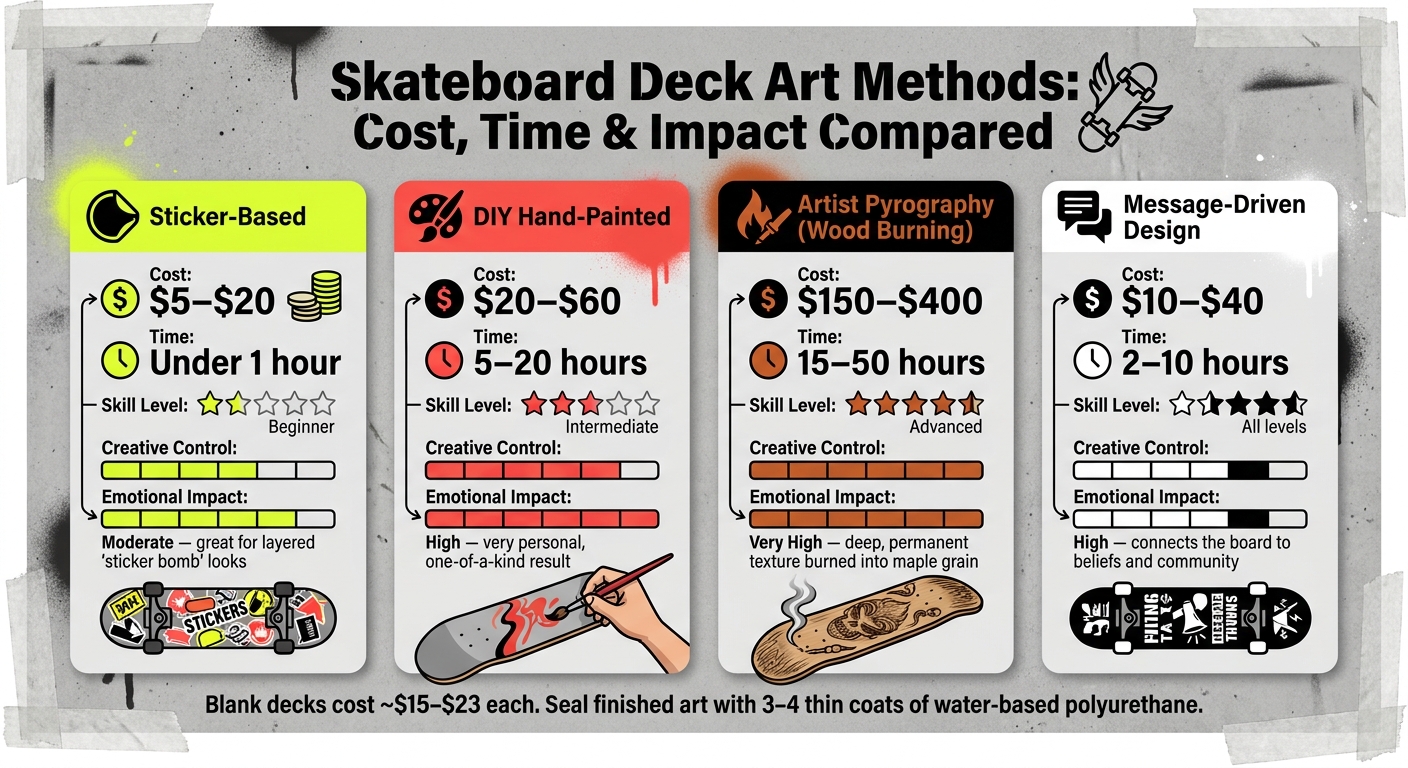
Skateboard Deck Art Methods: Cost, Time & Impact Compared
That same visual language doesn’t have to stop with the lines you throw up on the street. It can move straight onto your board.
A skateboard deck can work like a moving canvas for personality and style. It carries your look, your mood, and your point of view. In that sense, the board becomes part of the same visual language, not just something you ride.
From blank deck to personal statement
You don’t need a huge budget to start. A 3-pack of blank 7-ply Canadian maple decks costs about $40–$70, which puts each board at roughly $15–$23. That price makes trial and error a lot less stressful.
Then the tools start to shape the final look. Paint pens and acrylics in the $20–$50 range are good if you want clean lines, lettering, or small details. Stickers make it easy to build a design bit by bit, then swap parts out later. If you want something burned into the board for good, pyrography goes straight into the maple grain and gives you a texture paint just can’t fake. Basic wood burners start around $20–$50, while detail burners from Razertip or BurnMaster run about $150–$400.
That shift matters. Once you mark up the deck yourself, it stops feeling like a stock object and starts feeling personal.
For protection, seal it with 3–4 thin coats of water-based polyurethane. If the board will spend time outdoors, add UV protection too.
How deck graphics connect to streetwear and personal visual identity
Once the deck turns personal, it can spill into the rest of your style. The same graphic can show up on stickers, a hoodie, a hat, or a bag. One image starts doing more work.
That’s a big reason skateboard art feels tied so closely to personal visual identity. A deck graphic can begin as a one-off statement, then grow into a look people connect with you.
Deck art options compared: cost, control, and impact
| Method | Cost (USD) | Time Required | Skill Level | Creative Control | Emotional/Visual Impact |
|---|---|---|---|---|---|
| Sticker-Based | $5–$20 | Under 1 hour | Beginner | Medium | Moderate; works well for layered "sticker bomb" looks |
| DIY Hand-Painted | $20–$60 | 5–20 hours | Intermediate | High | High; very personal, one-of-a-kind result |
| Artist Pyrography | $150–$400 | 15–50 hours | Advanced | Very High | Very high; deep, permanent texture |
| Message-Driven Design | $10–$40 | 2–10 hours | All levels | High | High; connects the board to beliefs and community |
Pick the method that fits your budget, your time, and how permanent you want the result to be.
sbb-itb-e116ef9
Creative practices that turn skating into inner freedom
Creativity doesn’t have to end when the session does. A simple weekly rhythm can keep that spark moving between the street, your notebook, and your deck.
Simple routines readers can start this week
Use your commute or a short street session as a focused ride. Skating keeps you present and forces quick choices. That’s part of the pull: you’re not drifting through the day, you’re locked in.
After you ride, take a few minutes to sketch what stuck with you. Maybe it was a sidewalk crack, a steep hill, or the way the wind changed how a block felt under your wheels. Those small details can turn into sketches, notes, or deck ideas.
A few private notes after a session can also turn stress into clarity. Photos and quick sketches help you build a visual archive you can come back to later when you’re working on a deck or another piece.
Using city details as art prompts
The city starts to feel different when you stop treating it like background scenery. A rail, a ledge, or a rough patch of sidewalk isn’t just something to get past. It can also become a line, a texture, or a movement idea.
Carry a sketchbook, or just use your phone camera. Save what catches your eye. Later, those notes can shape deck art, mixed-media work, or simple drawing studies. The key is not to force it. Don’t turn every session into an assignment. Let the city hand you something worth keeping.
Expression methods compared: cost, time, and mental payoff
| Method | Typical Cost (USD) | Time Commitment | Equipment Needed | Key Benefit |
|---|---|---|---|---|
| Street Skating | $0 after board | 20–60 min/session | Skateboard, helmet | Stress reduction, quick decision-making, resilience |
| Sketching/Journaling | $5–$20 | 10–30 min | Sketchbook, pens | Reflection, grounding, creative reset |
| Deck Customization | Higher cost | Longer sessions | Tactile focus | A lasting object you can carry into daily life |
| Urban Observation | $0 | Ongoing | Phone or sketchbook | Inspiration, grounding, environmental appreciation |
Sketching and journaling are the easiest places to begin because they ask for very little time or money. Street skating can change your mood fast by putting you back in your body and back into the rhythm of the street. Urban observation costs nothing and can happen anywhere. It just asks you to slow down and notice more.
Over time, these small habits can make personal expression feel less like a side hobby and more like part of everyday life.
Purpose, community, and conclusion
When personal expression connects to something bigger
Once skating and making turn into habits, they stop feeling like private rituals. They start shaping the culture around them.
In July 2026, KJ Dillard joined Kenneth Cole's "Purposeful Voices" series to speak about vulnerability and mental health, joining The Mental Health Coalition to support mental-health resources. That kind of public sharing shows how personal expression can grow into a shared language. When skaters put their work out in the open, other people often see their own feelings in it too. And that matters. Expression hits harder when it helps someone else name what they’ve been carrying.
Key takeaways from this guide
This guide comes down to four ideas:
- Skating creates focus and emotional release.
- Deck art offers a direct expression of identity.
- Simple habits like sketching and urban observation help keep inspiration alive.
- Purpose-driven creativity can last beyond one session.
Show up, pay attention, and make something that feels like yours.
FAQs
How do I start if I’m new to skating and art?
Start by getting into skate culture through local shops and videos. That’s often where the best ideas show up. You see the attitude, the style, and the little details that make skate art feel like skate art.
For deck art, begin on paper. Practice hand lettering or rough sketches first, then move to the board with acrylic markers or stencils. Keep the design bold and simple. On a skateboard deck, clean shapes and strong lines usually hit harder than something overly busy.
As you get more comfortable, try new techniques like pyrography or play with different color palettes. Both skating and art get better the same way: through consistency and personal expression.
What deck art method is best for beginners?
Acrylic markers are the best starting point for beginners who want to customize a skateboard deck.
Start by sketching your design on paper. It gives you room to work out the lettering and adjust for the deck’s curves before you touch the board.
Once you move to the deck, use light strokes and keep the lettering bold and simple. Small details can disappear fast once the board starts getting used on the street or at the park. If you hold the marker at a 45-degree angle, you can change the line weight more easily and give the lettering a bit more character.
How can I make skating feel more mindful?
Treat each session as time to be present and express yourself, not just as exercise. Pay attention to what’s around you and to the rhythm of each movement. Hills, wind, and even cracks in the pavement don’t have to feel like problems - they can be part of the ride.
That same mindset can go beyond skating itself. You might customize your deck, try graffiti, do some pyrography, or sketch ideas that match your style. In that sense, skating can feel almost meditative. It helps you build confidence, face fear, and get a clearer sense of who you are.