
How art and skateboarding can improve your life.
If you feel stressed, stuck, or glued to a screen, art and skateboarding can help you feel better with simple daily habits.
I’d sum it up like this: art helps calm my mind, skateboarding gets my body moving, and doing both can help me feel more connected to other people. The article points to a few clear ideas: even 10–15 minutes of sketching can help settle my thoughts, a basic sketchbook often costs $10–$25, and beginner skate setup choices like a 7.5"–8.25" deck with 78a–85a wheels can make starting easier.
Here’s the full takeaway in plain English:
- Art helps lower stress by giving my hands and mind one thing to focus on.
- Sketching and visual journaling are cheap, simple ways to get started.
- Street photography helps me pay attention instead of drifting through the day.
- Skateboarding builds strength, balance, and stamina without feeling like a gym workout.
- Falling and trying again can build patience and self-trust.
- Art and skating together can shape my style, habits, and social life.
- Small, repeated habits matter more than perfect results.
The blurred lines of art and skateboarding | Poppy Starr Olsen | TEDxUltimo
sbb-itb-e116ef9
Quick comparison
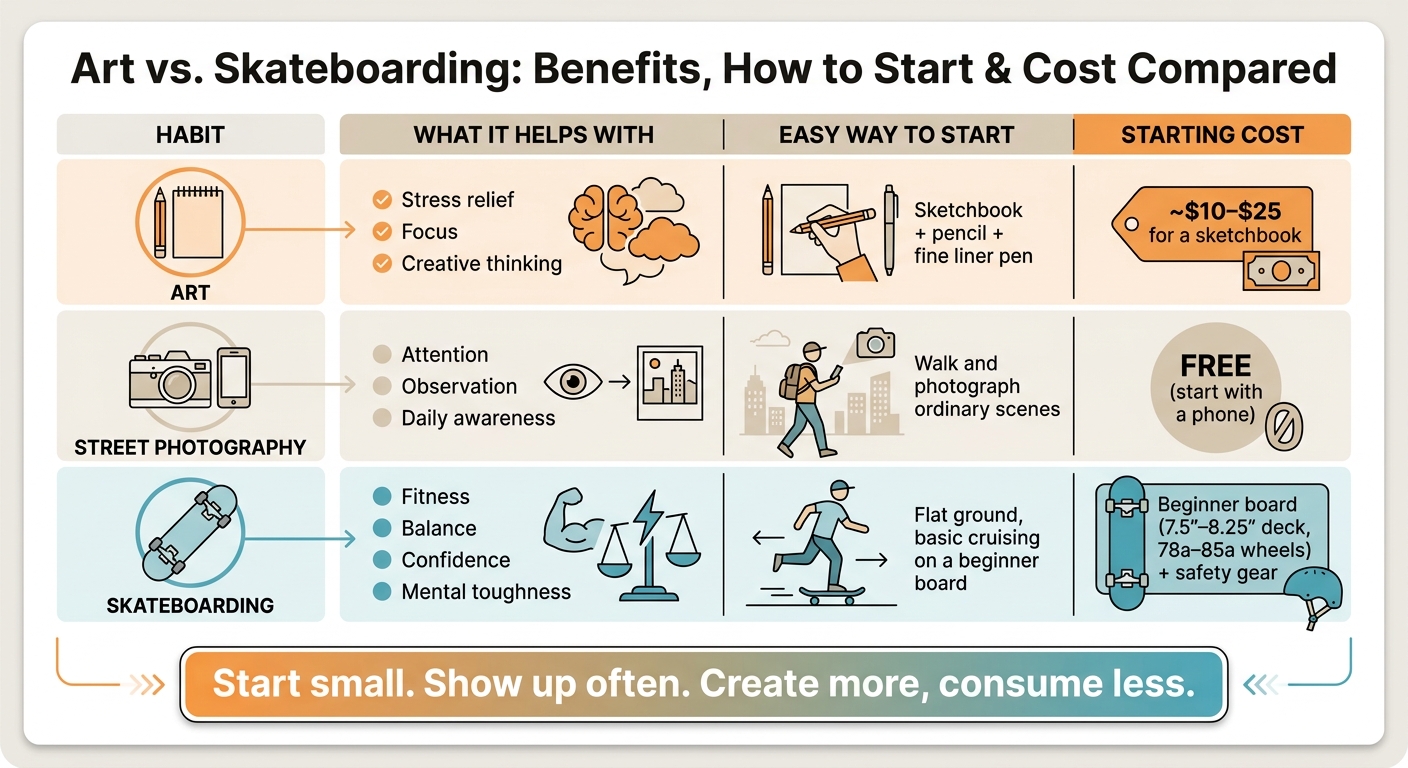
Art vs. Skateboarding: Benefits, How to Start & Cost Compared
| Habit | What it helps with | Easy way to start | Cost/start point |
|---|---|---|---|
| Art | Stress, focus, new ideas | Sketchbook, pencil, pen | About $10–$25 for a sketchbook |
| Street photography | Attention, observation, daily awareness | Walk and shoot ordinary scenes | Can start with a phone |
| Skateboarding | Fitness, balance, confidence | Flat ground, basic cruising | Beginner board + safety gear |
What I like about this article is its main point: create more, scroll less, and keep it simple enough to do every day.
How art reduces stress and gets you thinking again
When your brain feels maxed out, making art can help slow things down. It gives your hands a calm, repeated task, which can quiet racing thoughts.
You also don't need a studio or a pile of gear to start. A sketchbook is the easiest way in.
Use sketchbooks and visual journaling to clear your head
You can start with just a sketchbook, a pencil set from 2H to 6B, and a fine liner pen. A high-quality, acid-free sketchbook usually costs $10–$25.
Even 10 to 15 minutes of sketching, doodling, pattern drawing, or shading can give your mind one simple job to do and help your nervous system settle. Think quick pages, not polished work. The point isn't to make something perfect. It's to get thoughts out of your head and onto the page.
Use street photography to shake off autopilot
After sketching starts training your eye, street photography takes that same habit into daily life. It works because it nudges your brain to see, not just glance at things and move on. Pay attention to negative space, the empty area around a subject, and even ordinary scenes can start to look different.
That shift matters. Once you notice more, you often feel more in control of your day. And that habit carries over to the board too, where small adjustments can build control and confidence.
How skateboarding builds fitness, confidence, and mental toughness
If art clears your head, skateboarding gives that same focus a physical outlet.
Flat-ground skating - pushing, turning, and cruising - can build lower-body strength, coordination, and stamina. It gets you moving without feeling like a gym session, which is part of why people stick with it.
Start with basic routines that make exercise easier to start and stick with
Start with the basics, not tricks. You don’t need a skatepark to begin. A neighborhood street or any other flat ground is enough.
A steady beginner setup usually includes:
- a 7.5"–8.25" deck
- soft 78a–85a wheels
- a helmet with knee and elbow pads
That approach keeps the first steps simple. And when starting feels simple, it’s a lot easier to keep going. The same patience also makes the learning process feel less intimidating.
How falling and trying again builds discipline and self-trust
Falling is part of skating. Getting back up helps build self-trust and mental toughness. You miss, adjust, try again, and little by little, you get steadier.
Learning new tricks also rewards patience and persistence. That mindset doesn’t stay on the board. The same habit that helps you stand up after a fall can help you push through hard moments in daily life too.
How art and skateboarding together build identity and community
Once you start building discipline on the board and focus on the page, the next step is identity and community.
Art and skateboarding overlap more than most people think. Both grow out of DIY culture, where people make their own tools, style, and spaces. Deck graphics, hand-drawn zines, street photography, and custom gear all meet in the same lane. That’s often where personal identity starts to take shape.
Put the two together, and you start building a style, a voice, and a place to belong. You can usually see that momentum show up in what you wear, what fills your sketchbook, what’s under your feet, and who you spend time with. Your style on a board or on paper becomes a way to figure out what you actually like.
Build friendships through local scenes and shared projects
The move from a private habit to a public connection doesn’t need to be a big moment. Sometimes it’s as simple as bringing a sketchbook to the skatepark, taking street photos on the sidewalk, or showing up to a community art session. A sketchbook at the skatepark can start a conversation.
Show up often, and people start to recognize your work and your style. At skateparks, sidewalk spots, zine tables, and community art nights, those small interactions can turn into shared projects. One day it’s a quick chat. Next thing you know, it’s a group zine, a street photography session, or a deck customization hangout where everyone brings their own style.
Books like The Mutt by Rodney Mullen and Disposable by Sean Cliver show how skating and art can shape taste, voice, and identity.
When those ideas grow past a notebook page, they can turn into something worth sharing.
Use Carbonated Thoughts tools to bring your ideas to life
If a project turns into a deck graphic, brand, or small release, Carbonated Thoughts offers tools to help make it real: skateboards, apparel, stickers, and design support. For more inspiration, books like The Mutt by Rodney Mullen and Disposable by Sean Cliver belong in the mix.
Conclusion: Small daily habits can change how you feel and grow
After stress relief, fitness, and community, the takeaway is simple: start small and keep showing up. You don’t need to flip your whole life upside down. Art can help lower stress and bring you back to yourself. Skateboarding can build strength, confidence, and discipline. Put them together, and you get a simple way to reset, feel steadier, and keep growing.
What matters most is repeating the habit until it starts to feel normal.
That’s the heart of it: create more, consume less.
Key points to take with you
The biggest shift is moving away from perfection and toward consistency. That means sketching, skating, or taking photos on a regular basis without obsessing over the end result. A simple sketchbook, a pencil set, or a beginner board setup is enough to get going instead of drowning in choices. When you feel ready, bring that habit into your local skate spot or art scene. That’s usually how something private starts becoming part of everyday life.
FAQs
How do I start if I’m not artistic or athletic?
Getting started can feel like a lot. That’s normal. The trick is to focus on the process, not on doing everything perfectly from day one. You don’t need to be an expert. You don’t need to be an athlete either. You just need to begin.
With art, keep it simple. Start with a sketchbook and a few tools you can count on. That’s enough to get your hands moving and build the habit.
With skateboarding, pick a beginner-friendly setup and aim for small wins first. Get comfortable rolling before you worry about tricks. That early stage matters more than most people think.
Both are personal paths. Show up, put in the time, and let your confidence build little by little.
How often should I sketch or skate to feel a difference?
You don’t need a strict schedule to get something good out of sketching or skateboarding. What matters is the act itself, not turning out masterpieces or chasing some fixed milestone.
Even a casual doodle or a simple skate session can help ease stress, build confidence, and support your well-being when you feel like doing it.
What basic gear do I need to start safely and cheaply?
For skateboarding, the simplest low-cost pick is a complete skateboard. You get the full setup in one go: deck, trucks, wheels, bearings, and grip tape. That makes life a lot easier when you're starting out.
If you're new, look for a deck in the 8.0–8.25-inch range. It tends to feel more stable under your feet without being too bulky. Softer wheels, around 78a–85a, also help. They roll more smoothly and handle rough ground better, which can make those first sessions feel a little less shaky.
For art, keep it simple. Start with a quality sketchbook with 90–150 gsm paper and a few drawing tools or paint markers you can count on. You don't need a huge pile of supplies to get going. A small, solid setup is more than enough.